How Many Sq Ft Does a Yard of Concrete Cover? A Complete Guide for Accurate Ordering
The area a yard of concrete covers depends mainly on the slab thickness. This relationship is common for concrete slabs, sidewalks, and patios around homes.
For example, a slab 5 inches thick will cover about 65 square feet per yard of concrete. If you increase the thickness to 6 inches, that coverage drops to roughly 54 square feet per yard. Thicker slabs require more concrete, so coverage decreases as thickness grows.
Measure your project’s length, width, and thickness accurately in feet before ordering. Multiply these dimensions to get total cubic feet, then divide by 27 to convert to cubic yards. This method helps you order just the right amount of concrete, avoiding waste or shortages.
Key Takeaways
- One cubic yard of concrete covers approximately 81 square feet when poured to 4 inches thick.
- Thicker slabs reduce coverage; 5-inch slabs cover 65 sq ft per yard.
- Measure project size precisely in feet to get accurate concrete volume.
- Convert cubic feet to cubic yards by dividing total cubic feet by 27.
- Order extra concrete to allow for spillage or uneven site conditions.
- Use the slab thickness to adjust coverage estimates correctly.
How Many Square Feet Does One Yard of Concrete Cover?

One cubic yard of concrete covers roughly 81 square feet at 4 inches thick. Many driveways, patios, and garage floors use this thickness. You calculate this by multiplying area by thickness, then converting to cubic yards.
Thinner slabs cover more square feet per yard, while thicker slabs cover less. A 3-inch slab covers about 108 square feet per cubic yard. A 6-inch slab covers around 54 square feet per cubic yard.
Thickness affects how much area one yard covers. This difference matters for ordering the right concrete amount.
You want to avoid running short or wasting material. Accurate orders save time and money.
| Slab Thickness | Thickness in Feet | Coverage per Cubic Yard (Square Feet) | Typical Application |
|---|---|---|---|
| 2 inches | 0.167 ft | 162 sq ft | Patios, walkways |
| 3 inches | 0.25 ft | 108 sq ft | Light-duty slabs |
| 4 inches | 0.333 ft | 81 sq ft | Driveways, garage floors |
| 5 inches | 0.417 ft | 65 sq ft | Heavy-duty floors |
| 6 inches | 0.5 ft | 54 sq ft | Commercial slabs, heavy loads |
Here’s how you can check this yourself. Convert slab thickness from inches to feet first. Multiply thickness in feet by coverage area in square feet.
That gives you one cubic yard volume. For a 4-inch slab, multiply 0.333 feet times 81 square feet. This equals about 27 cubic feet, which is exactly one cubic yard.
Four inches is one-third of a foot, which affects coverage. That’s why one yard covers 81 square feet at this thickness. It’s a common measuring standard.
One cubic yard holds 27 cubic feet. Dividing 27 cubic feet by one-third foot thickness gives 81 square feet of surface area. This calculation repeats across all thicknesses, just changing the thickness factor.
How to Calculate Concrete Coverage for Any Project Size
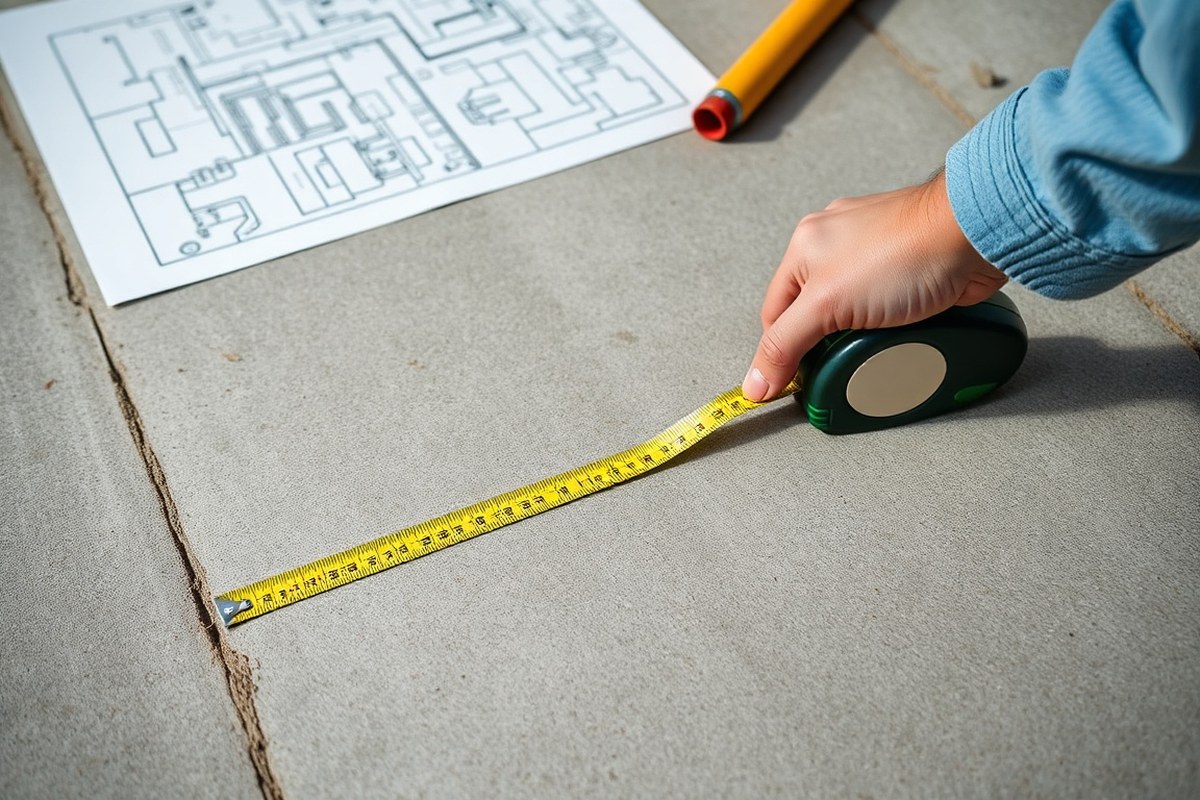
To calculate concrete coverage, find the slab’s length and width. Measure the thickness next. You need all three numbers to do the math.
Convert all measurements to feet or yards before using formulas. Multiply length, width, and thickness to get cubic feet. Then divide that by 27 to convert to cubic yards.
Step 1: Measure Length and Width Accurately
Use a tape measure or laser tool to measure length and width. Always measure in feet for this calculation. Use the outside edges to get the correct dimensions for your slab.
Divide the area into parts if it’s not a rectangle. Measure each part separately and add them later.
Write down your measurements carefully. Double-check each one before moving on to avoid mistakes.
Step 2: Convert Thickness from Inches to Feet
Concrete thickness is usually given in inches. To calculate volume correctly, convert inches to feet by dividing the thickness by 12.
For example, 4 inches becomes 4 ÷ 12 = 0.333 feet. This keeps all your units consistent.
Using feet simplifies multiplying dimensions for volume, which concrete suppliers use to figure yardage. Don’t forget this step; otherwise, your concrete amount will be wrong.
Step 3: Use the Coverage Formula to Calculate Cubic Yards Needed
Multiply your length, width, and thickness (in feet) to get volume in cubic feet. Then divide that number by 27, since 1 cubic yard equals 27 cubic feet.
- Multiply length (ft) × width (ft) to find the area in square feet.
- Multiply the area by the thickness (ft) to get volume in cubic feet.
- Divide the volume by 27 to convert cubic feet to cubic yards.
For example, a 10 ft by 10 ft slab that’s 4 inches (0.333 ft) thick is 10 × 10 × 0.333 = 33.3 cubic feet. Then 33.3 ÷ 27 = 1.23 cubic yards needed.
Remember to keep thickness in feet when calculating volume to avoid errors.
Step 4: Add Waste Factor and Adjust Order Amount
Concrete pours usually require extra to cover spill, uneven subgrade, or slight miscalculations. A typical waste factor is 5% to 10%. Multiply your calculated cubic yards by 1.05 or 1.10.
This extra accounts for mess-ups or settling. Ordering a little more prevents running short during your pour and wasting time. For example, if your slab needs 1.23 cubic yards, add 10%: 1.23 × 1.10 = 1.35 cubic yards, rounding up as your final order.
Why Slab Thickness Matters for Concrete Coverage
The thickness of your concrete slab changes how much area one yard covers. Thicker slabs mean less coverage per yard. You get less square feet covered with thicker slabs.
Thicker slabs use more concrete volume per square foot. So coverage decreases as thickness increases. Picking the right slab depth is critical to order enough concrete and avoid costly shortages.
Common Thicknesses for Residential Projects
Patios usually have slabs about 3 inches thick. Driveways and sidewalks are typically 4 inches.
Heavy-duty areas like garage floors often require 6 inches or more for durability. Each thickness fits different uses, strength needs, and weight loads.
Below is a table showing common thicknesses, their coverage per cubic yard, and typical applications. These numbers help you plan how much concrete to buy for your project.
| Thickness | Coverage per yd³ (sq ft) | Typical Use |
|---|---|---|
| 2 in (51 mm) | 162 ft² | Bonded toppings only |
| 3 in (76 mm) | 108 ft² | Mowing strips, light paths |
| 4 in (102 mm) | 81 ft² | Patios, walkways, shed pads |
| 5 in (127 mm) | 65 ft² | Driveways (cars) |
| 6 in (152 mm) | 54 ft² | Garages, RV pads |
| 8 in (203 mm) | 40 ft² | Commercial, footings |
Using this reference table helps you calculate material needs by matching your project’s slab thickness. It avoids ordering too little or too much concrete.
Impact of Thickness on Concrete Usage
Concrete volume is fixed per yard, 27 cubic feet. So spreading that volume thinner covers more area. When slab thickness grows, coverage goes down.
Thicker slabs use more concrete per square foot. This means less surface area per yard of concrete.
One cubic yard covers around 81 square feet at 4 inches deep but only about 54 square feet at 6 inches. Thickness changes the amount of concrete needed, so precise thickness matters before ordering.
Not counting thickness can make you buy too little concrete. This mistake can cause delays or rush order costs.
Always factor thickness to avoid these problems. Always calculate coverage using your slab’s planned thickness.
Adjusting for Uneven or Sloped Subgrade
Uneven soil or a sloped base changes the slab’s average thickness. Concrete filling low spots uses more volume than flat slabs.
This means more concrete needed for the same surface area. Low spots increase concrete use.
To handle this, measure the subgrade carefully and estimate the average depth, including any variation. You might need 10% to 15% extra concrete to cover these differences and avoid running short.
Ordering that extra bit can prevent work stoppages during the pour. Keep your slab depth consistent to achieve a strong, stable surface.
How Much Extra Concrete Should You Order to Avoid Running Short?
Ordering extra concrete prevents running short due to unexpected problems. Concrete waste comes from spills, uneven ground, and spreading concrete more than planned. Adding 5% to 10% extra material gives you a margin for safety.
This helps make sure you finish your entire pour in one go. It covers small mistakes and spills along the way.
Ordering just the exact amount risks running out halfway through. Concrete hardens quickly, so delays to get more cause cold joints. Cold joints weaken the slab and may cause cracks or uneven surfaces you want to avoid.
Site conditions also affect how much extra concrete to add. A flat, well-prepared site may need only 5% extra. Rough or uneven sites call for about 10% more concrete.
You need extra to fill low spots and cover spills. These conditions use more material than smooth sites.
- Add 5% extra for smooth, flat sites with good subgrades.
- Add 10% extra for uneven sites or over-excavated areas.
- Factor in extra for forms wider than the slab outline.
- Include extra if you expect heavy spillage or multiple partial pours.
- For large projects, a fraction of a yard saved this way avoids costly delays.
The extra concrete cost usually pays for itself. One yard of concrete typically costs $125 to $150. Delivery fees range from $60 to $100 if you order less than a full load.
Ordering extra material avoids costly overtime or extra truck fees. This saves money when you finish your pour without interruptions.
The simple rule: multiply your calculated volume by 1.05 to 1.10 depending on your site. For example, if your patio needs 2.37 cubic yards, order about 2.5 to 2.6 yards. This small buffer ensures you can deal with minor issues and spread concrete without rush.
Understanding Cubic Yards and Concrete Volume Basics
One cubic yard makes exactly 27 cubic feet of concrete volume. This number never changes. It shows the space the concrete fills, not its surface size.
This volume weighs about 4,050 pounds. The weight depends on the mix but usually stays close to this figure. Knowing the weight helps on-site handling and transport planning.
Concrete is sold by volume rather than area because depth varies. You can pour concrete thinner or thicker to cover more or less area. Measuring by volume ensures you get enough material regardless of slab thickness.
To figure out the area one yard covers, you convert your slab thickness into feet. Then divide 27 (cubic feet) by that thickness.
For example, a 4-inch slab is 0.33 feet thick. So 27 ÷ 0.33 equals about 81 square feet covered by one cubic yard.
Measure your slab thickness carefully first. Then convert it to feet. Use this number when calculating concrete coverage. That helps avoid ordering too little.
How to Calculate Coverage Using Bagged Concrete for Small Projects
You need about 45 bags of 80 lb concrete to equal one cubic yard. Each 80 lb bag covers roughly 1.8 square feet at a 4-inch thickness. Bagged concrete suits small jobs when you don’t need large volumes or a truck delivery.
Bag Sizes and Volume per Bag
Concrete comes in different bag weights like 40, 60, and 80 pounds. An 80 lb bag contains about 0.6 cubic feet of mixed concrete.
One cubic yard has 27 cubic feet. You need about 45 bags of 80 lb mix to make a yard.
Smaller bags, like 40 or 60 lb, cover less area and need more bags per yard. Knowing the volume in each bag helps you plan how many to buy for your job.
Calculating Coverage per Bag at Standard Thickness
Concrete coverage varies with slab thickness. An 80-pound bag covers 1.8 square feet at 4 inches thick. Thicker slabs use more concrete, reducing the area one bag can cover.
To calculate coverage, divide total cubic feet from a bag by slab thickness in feet. For example, 0.6 cubic feet per bag ÷ 0.33 feet thickness = 1.8 sq ft coverage per bag.
This helps figure out how many bags to buy. Measure your area and pick the slab thickness you want. Then calculate the bags needed.
Comparing Bagged Concrete vs. Ready-Mix Ordering
Ready-mix concrete costs around $140 to $200 per cubic yard. Bagged concrete runs much higher per cubic yard, about $383 to $450. Ordering a truck makes sense for big jobs of 1 cubic yard or more.
Bagged concrete fits small projects under 1 cubic yard or patching tasks. It avoids minimum truck loads and extra short-load fees that cost $50 to $100.
Use bags when you want convenience and small quantities. For bigger slabs, a ready-mix truck is more cost-effective.
| Concrete Type | Bag Size | Cost per Bag | Bags per Cubic Yard | Coverage per Bag at 4 in. | Best For |
|---|---|---|---|---|---|
| Quikrete | 80 lb | $8.50, $10 | 45 | 1.8 sq ft | Small DIY jobs, patches |
| General Purpose | 60 lb | $6.50, $8 | ~60 | Less than 1.8 sq ft | Small repairs, minor projects |
| Ready-Mix Truck | , | $140, $200/cu yd | , | 81 sq ft at 4 in. | 1+ cubic yard slabs, large pours |
Common Mistakes When Estimating Concrete Coverage and How to Avoid Them
Forgetting to convert inches to feet when measuring thickness is a common mistake. Since concrete coverage depends on thickness, mixing units can lead to big errors. For example, 4 inches equals 0.33 feet, and using inches directly in calculations could cause you to buy too much concrete.
Under-ordering often happens because people don’t account for uneven slabs or project slopes. Concrete volume needs to include these irregularities to avoid shortages. Over-ordering happens when you ignore project details.
Adding too big a buffer without reason causes waste. This leads to higher costs for materials and disposal.
Handling uneven slabs means measuring the lowest and highest points. Take the average thickness or break the area into sections and calculate volume for each separately.
Slopes require treating the area like a wedge. Multiply the area by the average depth to find the needed volume.
- Always convert slab thickness from inches to feet before volume calculation.
- For uneven slabs, measure thickness at multiple spots, then average those.
- Divide large or sloped areas into smaller zones to fine-tune volume needs.
- Order about 10% extra concrete to cover spillage and slight miscalculations.
- Use the coverage table for different thicknesses to estimate square feet per yard.
- Check coverage per bag before ordering bagged concrete. Know your slab thickness to calculate amounts.
- Double-check all area measurements and unit conversions before ordering.
This approach helps you get closer to the right order size. Measuring carefully avoids costly shortages or excess. It also reduces leftover concrete waste, which can be tricky and costly to dispose of properly.
Concrete Coverage Differences: Cubic Yards vs. Cubic Meters
You get more concrete with a cubic meter than a cubic yard. A cubic meter equals about 1.31 cubic yards.
That means it provides roughly 31% more volume. This difference changes how much area you can cover with each unit.
To find coverage, look at a slab 4 inches thick. One cubic yard can cover around 81 square feet at that thickness.
One cubic meter covers about 107 square feet at 4 inches thick. This info helps with projects measured in US or metric units.
Converting between the two involves simple math. Multiply cubic yards by 0.7646 to get cubic meters.
To go the other way, multiply cubic meters by 1.31 for cubic yards. You can use these conversions to order the right amount of concrete and avoid mistakes.
| Volume Unit | Volume in Cubic Feet | Approx. Coverage at 4 Inches Thick (sq ft) |
|---|---|---|
| 1 Cubic Yard | 27 | 81 |
| 1 Cubic Meter | 35.3 | 107 |
| 24×24 ft Slab at 4″ | – | 7.11 Cubic Yards Needed |
| 10×10 ft Slab at 4″ | – | 1.23 Cubic Yards Needed |
Use the conversion factor in ordering if your project specs mix units. It avoids buying too little or too much concrete. For example, a 10-by-10-foot slab at 4 inches takes about 1.23 cubic yards, or 0.94 cubic meters of concrete.
Always double-check your conversions and round up slightly to prevent running short.
Step-by-Step Action Plan for Ordering and Pouring Concrete
Follow this plan to measure, order, and pour the right amount of concrete for your project. It helps you avoid waste and costly delays.
- Before you start: Measure the length, width, and planned thickness of your slab. Use these numbers to calculate the total volume in cubic yards.
- Day 1: Use your volume calculation to order concrete. Add at least 10% extra to cover spills and uneven surfaces.
- Before pouring: Check the slab thickness requirements for your project type. Confirm the concrete mix matches those specs.
- Pour day: Pour the concrete evenly across the area. Use tools to smooth and level it quickly before it sets.
- Day 2: Keep the concrete moist by covering or spraying water. This prevents cracking and helps curing.
- After 7 days: Check the slab firmness by pressing with your thumb. It should feel hard with no soft spots.
- Two weeks later: Remove any forms and inspect the slab surface for evenness. Fill small holes if needed.
Frequently Asked Questions
How Many Square Feet Does One Yard of Concrete Cover at 6 Inches Thick?
One yard of concrete covers about 54 square feet at 6 inches thick. Thicker slabs reduce coverage because you use more concrete per square foot.
How Do I Calculate Square Feet Coverage for a Concrete Walkway?
Multiply the walkway’s length by its width to get square feet. Use slab thickness and volume formulas to determine how much concrete you’ll need.
Why Does Concrete Shrinkage Affect How Many Square Feet One Yard Covers?
Concrete shrinks slightly as it cures, but it doesn’t affect coverage much. Plan for shrinkage by placing a small extra amount or control joints.
What Is the Typical Square Feet Coverage for a 3-inch Thick Concrete Slab?
For a 3-inch slab, one yard covers about 108 square feet. Thinner slabs mean more surface area coverage from the same volume.
Can the Presence of Reinforcement Steel Affect Concrete Coverage Calculations?
No, steel doesn’t change concrete volume or coverage. Account for steel separately in project planning and costs.
How Does Weather Impact How Much Concrete You Need per Square Foot?
Hot, dry weather can cause concrete to dry faster and shrink more. You may need slightly more mix or use curing methods to prevent cracks.
Before You Go
A single cubic yard of concrete spreads 81 square feet at 4-inch depth. Figure out your slab depth to order the right quantity. Measure your area today to calculate exactly how much concrete you need.