How Many Tons in a Yard of Asphalt: A Complete Guide with Worked Examples
Trying to figure out how many tons in a yard of asphalt? The quick answer is about 1.9 to 2 tons per cubic yard. This range covers typical hot-mix asphalt at normal compacted density around 145 pounds per cubic foot.
Keep in mind, asphalt thickness and density change the total tonnage. One cubic yard of asphalt weighs about 3,960 pounds. This assumes it is packed to standard density.
That equals close to 1 ton.98 tons. Small changes in thickness can affect your order size and cost a lot.
Start by knowing your project’s thickness in inches and measuring the area in square yards. Use these numbers and multiply by the spread rate. The rate is 110 pounds per square yard per inch thick.
This gives a good estimate of tonnage. Double-check density especially if using recycled or cold mix, as those weigh a bit less.
Key Takeaways
- One cubic yard of asphalt weighs roughly 1.9 to 2 tons at standard density.
- Thickness directly multiplies the total tonnage needed per square yard.
- Asphalt density ranges between 140 and 150 lbs per cubic foot.
- Use 110 pounds per square yard per inch thickness for spread rate calculations.
- Recycled or cold mix asphalt weighs slightly less than hot-mix asphalt.
- Measure your paving area accurately in square yards before ordering.
How Many Tons Are in a Yard of Asphalt?
One cubic yard of hot-mix asphalt typically weighs about 1.9 to 2.0 tons. The common average density used for calculations is around 145 pounds per cubic foot. At this density, one cubic yard equals roughly 3,915 pounds, or about 1.96 tons.
The exact weight varies because asphalt density depends on the mix type and compaction level. Hot-mix asphalt weighs between 140 and 150 pounds per cubic foot. This weight applies once the asphalt is compacted.
The measurement is important for calculating material needs.89 to 2.03 tons per cubic yard. Loose or freshly placed asphalt weighs less, sometimes down to about 1.76 tons per cubic yard.
To find tons from cubic yards, first multiply cubic yards by 27. Then multiply by the density in pounds per cubic foot.
Divide the result by 2,000 to get tons. Using 145 pounds per cubic foot, one cubic yard equals about 1.96 tons.
How Asphalt Thickness and Density Affect Tonnage
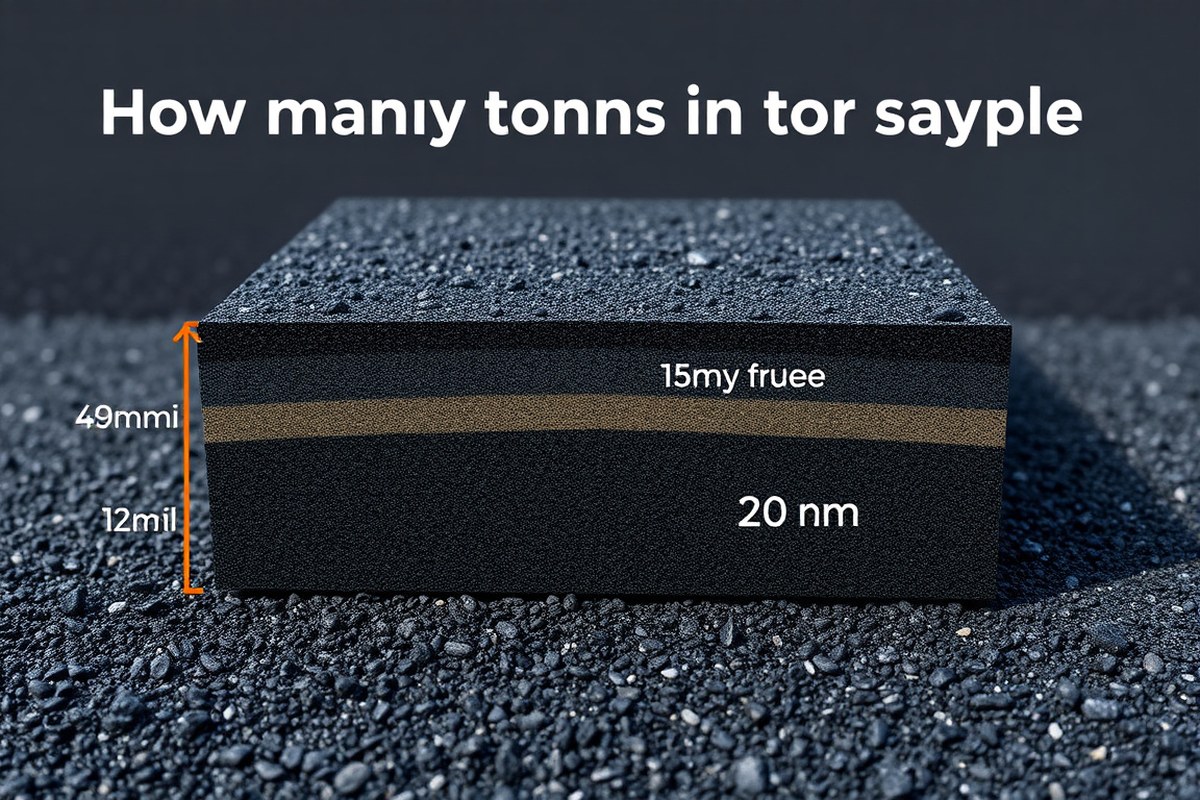
The thickness of your asphalt layer affects the total tons needed because thickness changes the volume. Double the thickness, and you almost double the volume and weight.
For example, 2 inches thick needs twice as many tons. This is over the same area as 1 inch thick.
Density varies based on the asphalt mix and moisture content. Typical compacted asphalt density ranges from about 140 to 150 pounds per cubic foot. Hot-mix asphalt often averages around 145 pounds per cubic foot.
But reclaimed or wet mixes can be lighter. You need to use the specific density your supplier gives to get a precise tonnage estimate.
Compaction significantly changes density. Freshly laid asphalt is less dense because it contains air and sometimes moisture. After rolling and curing, it compresses and gains weight per cubic yard.
Plan for a 5% to 10% density increase from compaction. This helps you avoid ordering too little asphalt.
First, convert area and thickness into cubic yards. Then multiply by the right density. This converts volume into weight.
To get tons, multiply square yards by 9. Then multiply by thickness in feet and material density.
Finally, divide by 2,000. Adjust thickness in inches by dividing by 12 first.
Always check the mix density your supplier gives you. Adjust thickness for compaction to avoid underestimating asphalt.
Step-by-Step Calculations from Cubic Yards to Tons
To convert cubic yards of asphalt into tons, you first find the volume in cubic feet. Then you multiply by the asphalt’s density in pounds per cubic foot. Finally, divide by 2,000 to get tons since one short ton equals 2,000 pounds.
Calculate Volume in Cubic Feet
Start by converting the volume from cubic yards to cubic feet. One cubic yard equals 27 cubic feet, so multiply your cubic yards by 27. This gives you an accurate volume measure based on length, width, and depth.
For example, a 3-cubic-yard pile of asphalt equals 81 cubic feet. Keeping units consistent helps avoid calculation errors. Make sure thickness or depth is in feet when multiplying.
Multiply Volume by Asphalt Density (Lbs/ft³)
Asphalt density usually ranges around 145 pounds per cubic foot. Multiply your volume in cubic feet by this density number. This step converts volume into weight in pounds.
Using 81 cubic feet and 145 pounds/ft³ density, multiply 81 × 145. That equals 11,745 pounds of asphalt for your project. Check the supplier’s density for best accuracy.
Convert Pounds to Tons by Dividing By 2,000
Divide the total pounds by 2,000 to get tons, since one ton equals 2,000 pounds. For 11,745 pounds, dividing by 2,000 gives about 5.87 tons. This is your asphalt weight in tons.
Order slightly more asphalt than calculated, typically 5 to 10%. This covers waste and compaction loss during paving. Follow these steps to go from cubic yards to tons in your asphalt project:
- Measure the asphalt volume in cubic yards you will need.
- Multiply cubic yards by 27 to convert to cubic feet.
- Confirm or estimate your asphalt density, usually about 145 pounds per cubic foot.
- Multiply the cubic feet volume by the density to get weight in pounds.
- Divide the weight in pounds by 2,000 to convert to tons.
- Add 5 to 10 percent extra material for waste and compaction.
- Double-check your supplier’s density if ordering hot-mix asphalt.
- Use this tonnage for your supplier order or cost estimate.
Converting Square Yards and Thickness to Tons of Asphalt
To convert square yards and asphalt thickness to tons, start by multiplying area by thickness. Next, multiply that by the spread rate. Finally, divide the result by 2,000.
The standard spread rate is 110 pounds per square yard per inch. This quick method helps you estimate how much asphalt you need before ordering.
Determine Surface Area in Square Yards
Start by measuring the length and width of your paved area in feet. Multiply these numbers to get the total square footage.
Divide by 9 to convert square feet into square yards. This works because one square yard equals 9 square feet.
For example, a 12-foot by 50-foot driveway covers 600 square feet. Divide 600 by 9 to get about 66.7 square yards. This is the base for your tonnage calculation.
Multiply by Planned Thickness in Inches
Identify the planned asphalt thickness, usually between 2 and 4 inches for most driveways. Multiply your square yard number by this thickness in inches. This step accounts for the vertical volume of asphalt needed.
For instance, at 3 inches thickness, multiply 66.7 square yards by 3. That gives a figure representing square yards times inches, an important volume measure in weight estimation.
Apply Asphalt Spread Rate and Convert to Tons
The spread rate for hot-mix asphalt is typically 110 pounds per square yard per inch. Multiply your area-thickness product by 110 to get the weight in pounds. Then divide by 2,000 to convert pounds to tons, which is the usual purchase unit.
Using the 66.7 square yards at 3 inches example: 66.7 × 3 × 110 = 22,011 pounds. Dividing 22,011 by 2,000 equals about 11 tons of asphalt. This is the basic formula to estimate tonnage quickly and accurately.
Follow these steps to convert your paving dimensions into tons of asphalt needed:
- Measure length and width of the area in feet.
- Calculate area in square feet by multiplying length × width.
- Convert square feet to square yards by dividing by 9.
- Determine the planned asphalt thickness in inches.
- Multiply square yards by thickness to get volume factor.
- Multiply volume factor by 110 to estimate weight in pounds.
- Divide pounds by 2,000 to convert to tons.
- Add 5%, 10% for waste and compaction losses if desired.
Keep an eye on density variations between asphalt mixes. The spread rate of 110 pounds per square yard per inch assumes typical hot-mix asphalt.
Denser mixes or different compaction may change your numbers slightly. Check with your supplier to confirm the exact specs before ordering.
For a standard 3-inch thick residential driveway, expect about 0.165 tons per square yard or 330 pounds. This helps you quickly verify estimates. Double-check your measurements and thickness before placing an order when calculations vary widely.
Worked Examples for Driveways and Parking Lots
To find how many tons of asphalt you need, first measure the area. Multiply the area by the thickness of the asphalt. Then, adjust that result by the asphalt’s density.
For a typical 40×12 foot driveway at 3 inches thick, expect around 5 tons. A 500 square yard parking lot at 4 inches will take about 100 tons. Always add some percentage for waste and compaction.
Example 1: Residential Driveway Calculation
A 40-by-12-foot driveway equals 480 square feet. Residential driveways typically use 2 to 3 inches of asphalt thickness.
Using 3 inches for a heavy driveway, coverage is about 6.1 square yards per ton. Calculate tons step-by-step to get an accurate estimate.
- Convert square feet to square yards: 480 ÷ 9 = 53.3 SY.
- Use coverage per ton for 3 inches thickness: 6.1 SY/ton.
- Divide area by coverage: 53.3 ÷ 6.1 ≈ 8.74 tons.
- Consider density variation; 2.2 tons per cubic yard is typical.
- Check cubic yards: (40×12×0.25 ft) ÷ 27 ≈ 4.44 CY.
- Multiply cubic yards by density: 4.44 × 2.2 ≈ 9.77 tons.
- Average values: estimate 9 to 10 tons before waste.
These calculations show different methods. Weight per cubic yard varies by mix and compaction.
Example 2: Commercial Parking Lot Estimate
A 500-square-yard parking lot at 4 inches requires more asphalt. Commercial lots usually call for 3 to 5 inches thickness for medium traffic. Use the 4.6 square yards per ton coverage for 4 inches to start the calculation.
- Confirm total area: 500 square yards.
- Divide area by coverage: 500 ÷ 4.6 ≈ 108.7 tons.
- Calculate volume in cubic yards: (500 × (4 ÷ 12)) ÷ 9 = 18.5 CY.
- Multiply volume by density: 18.5 × 2.2 = 40.7 tons (lighter density estimate).
- Average results: Between 100 and 110 tons likely needed.
- Adjust numbers if density is higher or lower.
Estimating by square yards and thickness is easier for ordering. Verify with project specs for the best accuracy.
Adjusting Quantities for Waste and Compaction
Adding 5 to 10 percent extra accounts for waste and compaction. Waste happens during delivery and spreading. Compaction reduces volume, so ordering slightly more material ensures full coverage.
- Calculate base tons needed from your estimates.
- Multiply tons by 1.05 to 1.10 for waste allowance.
- Confirm final order with your asphalt supplier.
- Note project type and traffic for density adjustments.
Ordering too little asphalt can delay your project and cost extra shipping fees.
Common Mistakes and How to Avoid Them When Estimating Asphalt Tonnage
Confusing cubic yards with square yards often causes big errors in tonnage estimates. Cubic yards measure volume, while square yards measure area. Forgetting that asphalt depth affects volume means you might order too much or too little material.
Not accounting for asphalt compaction and waste also skews results. Asphalt compresses after being laid, reducing volume by up to 15%.
Leftover material or spillage adds to waste. Ignoring these factors can leave you short or paying for extra material you don’t use.
- Mixing square and cubic yards without adjusting for thickness
- Using old estimates without checking the current asphalt density
- Overlooking compaction, leading to ordering less than needed
- Forgetting about waste, especially on uneven or rough surfaces
- Relying on supplier numbers without verifying them
- Not measuring the project area accurately before calculating
Always clarify whether you’re measuring area or volume first. Work out volume by multiplying square yards by thickness in yards. Convert this to tons using known densities, about 145 pounds per cubic foot for hot mix.
Add 10 to 15% extra to cover compaction and waste. This extra ensures your order size matches actual needs. Factor this in when planning your asphalt amount.
Before buying, consult your supplier to confirm their density figures. Then, recalculate so the amount fits your exact project measurements and conditions.
How Different Asphalt Mix Types Change Weight and Coverage
Different asphalt mixes vary in density, affecting weight and coverage. Hot-mix asphalt generally weighs more than cold mix or recycled varieties. This difference matters when you calculate how many tons you need.
You convert from cubic yards or square yards to tons. Knowing the weight per volume helps you get it right.
The table shows typical densities and tons per cubic yard for common asphalt mixes. Hot mix standard weighs about 145 pounds per cubic foot, equal to 1.96 tons per cubic yard. Cold mix and recycled asphalt weigh about 140 pounds per cubic foot.
That equals roughly 1. This weight is lighter than hot mix asphalt.89 tons per cubic yard.
| Mix Type | Weight (lbs/ft³) | Weight (kg/m³) | Tons per Cubic Yard | Notes |
|---|---|---|---|---|
| Hot Mix (HMA) Standard | 145 | 2,323 | 1.96 | Default for most calculations |
| Dense Graded HMA | 148 | 2,371 | 2.00 | High-traffic roads |
| Warm Mix Asphalt | 143 | 2,291 | 1.93 | Lower production temperature |
| Cold Mix Asphalt | 140 | 2,243 | 1.89 | Patching, rural roads |
| Recycled Asphalt Pavement (RAP) | 140 | 2,243 | 1.89 | Recycled material |
| Porous / Open-Graded | 125 | 2,002 | 1.69 | Drainage pavements |
| Polymer-Modified | 148 | 2,371 | 2.00 | High performance |
The weight differences come from variations in aggregate size and mix design. Hot mixes use denser aggregates or higher compaction temperatures, making them heavier. Cold mix and recycled asphalt have larger voids inside them.
This means they are less dense and weigh less per volume. The extra air space lowers their weight.
Adjust your tonnage calculations based on mix type for accuracy. Using 1.96 tons per cubic yard works well for standard hot mix.
For cold mix or recycled asphalt, use about 1.89 tons per cubic yard. Overestimating can waste money, while underestimating risks running short on material.
Checklist and Decision Rules for Ordering Asphalt Accurately
You need several key details before ordering asphalt. Confirm project dimensions, desired asphalt thickness, and mix type. Check if the area has slopes or irregular shapes, which affect volume and waste.
Adding extra material prevents running short. Order 5 to 10 percent more asphalt than calculated volume. This overage covers waste from spillage, trimming edges, and compaction changes during paving.
- Measure length and width of the paving area accurately
- Decide on asphalt thickness in inches or feet
- Identify the asphalt mix type (binder, surface, etc.)
- Calculate volume in cubic yards for the total area
- Add a 5, 10% buffer for waste and compaction
- Split orders for binder and surface layers if needed
- Check delivery schedules and batch sizes with the supplier
Small, simple residential jobs rarely need an estimator. But call a professional when paving large areas over 1,000 square feet or with complex slopes. Professionals use laser tools and software for precise volume and waste estimates.
Complicated projects may also need separate orders for binder and surface layers. The binder layer often requires compaction before the surface asphalt goes down. Scheduling different deliveries keeps construction efficient and avoids delays.
Don’t skimp on overage. Ordering too little leads to costly delays and extra delivery fees.
Step-by-Step Action Plan for Estimating Asphalt Tonnage
Follow these steps to get accurate asphalt quantity estimates for your project. Each step ensures you stay on track and avoid common mistakes.
- Before you start: Measure the area in square yards and decide on your asphalt thickness. Check your measurements twice to avoid errors.
- Day 1: Calculate cubic yards by multiplying area by thickness (in yards). Use this to find the volume you need.
- Day 2: Choose the asphalt mix type you want. Note its typical density in tons per cubic yard to adjust your calculations.
- Day 3: Convert cubic yards to tons using the density. This gives a proper weight for ordering.
- Before ordering: Add a 5-10% waste factor to cover compaction and spillage. Confirm with your supplier if unsure.
- At ordering: Provide your contractor or supplier with your tonnage estimate and surface details. Double-check your numbers with them.
- After paving: Compare the actual tons used against your estimate. Learn from any discrepancies for future projects.
Frequently Asked Questions
How Many Pounds Are in a Cubic Foot of Asphalt?
Asphalt weighs roughly 140 to 155 pounds per cubic foot. This varies with the mix and moisture content.
Is Recycled Asphalt Lighter Than Hot-Mix Asphalt?
Yes, recycled asphalt typically weighs 120 to 140 pounds per cubic foot. It’s generally lighter than hot-mix asphalt because of its composition.
What Thickness of Asphalt Is Standard for Residential Driveways?
Residential driveways usually have 2 to 3 inches of asphalt. This thickness balances durability and cost for most homeowners.
How Does Moisture Affect Asphalt Weight?
Moisture can increase asphalt’s weight during transport and laying. It makes estimating tons slightly trickier, so check with your supplier.
Can Temperature Impact Asphalt Density During Paving?
Yes, hotter temperatures make asphalt easier to compact and slightly denser. Cooler weather might require adjustments in thickness or compaction effort.
Why Is Compaction Important in Calculating Asphalt Tonnage?
Proper compaction reduces voids, increasing density and tonnage needed. Skimping on compaction can lead to ordering the wrong amount.
The Bottom Line
Knowing how many tons are in a yard of asphalt helps. It stops you from ordering too much. It also prevents ordering too little.
Use your measurements and mix density to calculate weight right. Next, get a quote based on your tonnage and check local suppliers for the best prices.