

How to Apply Lawn Fertiliser: Simple Steps for Even Coverage and Healthy Growth
Applying lawn fertiliser the right way makes a big difference. Spread it evenly to avoid patchy growth or burning spots. Use a spreader and keep a steady pace for best results.
Measure your lawn first to apply the correct amount. Usually, 1 to 2 pounds per 1,000 square feet works well. Avoid fertilising when the ground is dry or if temperatures go above 80°F.
Water your lawn right after fertilising to help nutrients soak in. Use about a quarter inch of water evenly over the lawn. Don’t overwater, or the fertiliser could wash away.
Avoid fertilising before heavy rain to prevent runoff that harms plants. Pick a calm, low-wind day to keep fertiliser from drifting. Store leftovers in a cool, dry place away from pets and kids.
Key Takeaways
- Use a drop or broadcast spreader for even fertiliser coverage.
- Measure your lawn and calculate how much fertiliser to apply.
- Apply 1-2 pounds of fertiliser per 1,000 square feet.
- Water the lawn thoroughly 1-2 days before fertilising.
- Avoid fertilising when temperatures exceed 80°F or the lawn is dry.
- Apply fertiliser when no rain is expected for 24 hours.
How to Apply Lawn Fertiliser for Even Coverage
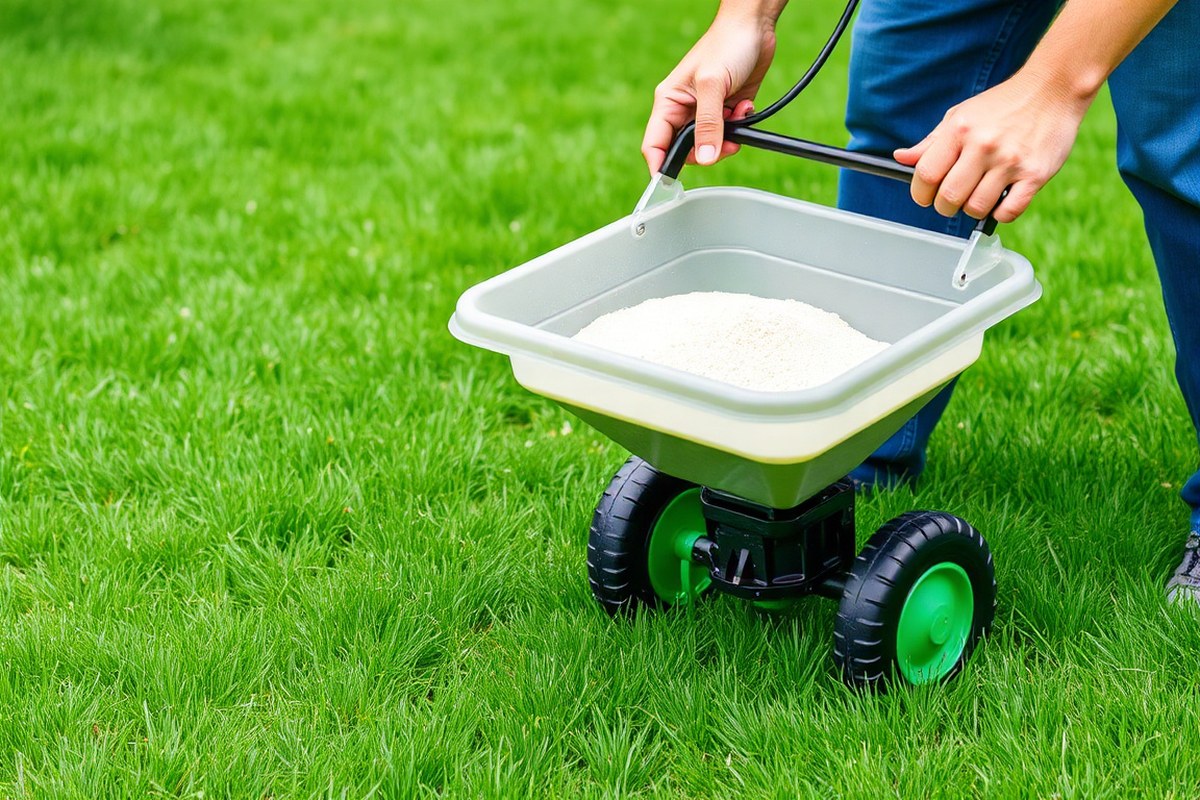
Apply fertilizer evenly by walking at a steady pace and overlapping your passes by 50%. Use a spreader to cover your lawn in sections. Work on about a quarter or a third of the lawn at a time.
This makes it easier to cover evenly. Measure your lawn area first to calculate the exact fertilizer amount needed.
Measuring Your Lawn Area Accurately
Start by measuring your lawn’s length and width for rectangular areas. Multiply these two numbers to get the square footage. For irregular shapes, divide your lawn into rectangles or squares.
Measure each shape carefully. Then add all the areas together for total size.
For example, a lawn 25 feet long and 40 feet wide is 1,000 square feet. Multiply length by width to get total area. This helps with measurements.
Use a tape measure or a measuring wheel for best accuracy. This helps you avoid under or over applying fertilizer, which can damage grass or waste product.
Calibrating Your Spreader with a Test Zone
Mark a 10-by-10-foot test zone to check how much fertilizer your spreader releases. Fill the spreader with fertilizer. Apply it as you walk across the lawn.
Keep your walking speed steady as planned. Weigh the fertilizer used and adjust the spreader setting if needed.
For example, if the rate is 1 pound per 1,000 square feet, applying to 100 square feet means 0.1 pound. Adjust the amount for smaller zones.1 pounds. Convert this to ounces: 1 pound equals 16 ounces.
So 0.1 pounds is 1.6 ounces. Adjust your spreader until it delivers about 1.Use 6 ounces of fertilizer in your test zone.
Walk steadily, usually around 3 miles per hour. This helps apply the right amount evenly.
Applying in Overlapping Passes
Use the 50% overlap rule when applying fertilizer with a broadcast spreader. This means each pass covers half of the previous one, preventing stripes and bare spots. Keep a steady pace to match your spreader calibration, typically about 3 miles per hour.
Walk in parallel lines, then switch directions to cross-apply for even better coverage. Avoid stepping on freshly spread fertilizer to keep granules evenly distributed. This method helps you achieve a uniform lawn without missing spots or applying too much fertilizer.
- Calculate your total lawn area by measuring length and width.
- Mark a 10×10 ft test zone to calibrate your spreader.
- Fill your spreader and walk the test zone at steady pace.
- Weigh fertilizer collected or used in the test zone.
- Adjust spreader settings to apply the target amount per zone.
- Apply fertilizer to your lawn in sections, covering 1/4 to 1/3 each time.
- Walk in parallel lines using 50% overlap for each pass.
- Go over the lawn a second time in the opposite direction.
When to Fertilize Your Lawn for Best Results
Fertilize your lawn when grass starts growing. The soil should be warm. Avoid very hot soil.
Morning hours work best to keep nutrients from burning your grass. Match fertilizer timing to your grass type.
Check soil temperature and weather. This helps nutrient absorption.
Timing by Grass Type and Season
Cool-season grasses grow best in spring and fall. Start feeding them in mid to late spring once soil hits about 50 to 55°F. In early spring, use fertilizer with high nitrogen. Choose one low in phosphorus and potassium.
For example, use a 24-2-11 formula. Add more potassium in early fall.
Try a 32-0-10 fertilizer. This gets grass ready for winter.
Warm-season grasses do well with feeding in late spring. Soil temperature should stay above 60°F. Feed again in summer once grass grows. Use balanced fertilizers, such as a 16-4-8 mix, to boost steady growth.
Avoid feeding cool-season grasses during hot summer or drought. It stresses the lawn. Fertilizer then is wasted.
Soil Temperature and Moisture Impact
Check soil temperature before fertilizing. Fertilize cool-season grasses once soil stays above 50°F. For warm-season grasses, wait until soil is around 60°F. Fertilizing in cold soil slows nutrient absorption and wastes product.
Moist soil improves nutrient uptake. So fertilize when the ground is moist but not soggy or frozen.
Avoid application on baked or waterlogged soil. After fertilizing, watering helps move nutrients into the root zone within 24 hours.
Best Time of Day to Fertilize
Morning is the best time to apply fertilizer. Cooler temperatures reduce evaporation and prevent fertilizer from burning grass blades. Applying early lets nutrients soak in before the day’s heat stresses the lawn.
Avoid midday fertilizing, especially during hot weather. Sunny afternoons dry fertilizer too fast and increase the risk of leaf burn. Late afternoon or evening could leave fertilizer wet overnight, risking runoff or disease.
Weather Conditions to Watch
Do not fertilize if rain is expected within 24 hours. Heavy rain can wash fertilizer away before grass absorbs nutrients. Plan applications during dry stretches followed by light watering.
Avoid fertilizing during drought or heat waves, especially with cool-season grasses. Fertilizers can worsen stress and damage the lawn without enough moisture. Wait for cooler weather and soil moisture to return before feeding again.
Check local weather for at least 24 hours before spreading fertilizer to avoid nutrient runoff.
Choosing the Right Type of Fertiliser for Your Lawn
Granular and liquid fertilizers differ in how they deliver nutrients to your lawn. Granular types release nutrients slowly and need watering to work.
Liquid fertilizers absorb fast and give quick results. Your choice depends on lawn needs, grass type, and desired feeding speed.
Granular Fertilizer Characteristics
Granular fertilizers release nutrients slowly, typically over 5 to 14 days. They work best as a base feeding for your soil, helping build long-term health. Using a spreader is common, with equipment costing between $45 and $130.
Granular fertilizers usually cost around $35 to $45 per bag for 14,000 square feet. They require about 0.25 to 0.5 inches of irrigation right after applying. This moves nutrients into the soil and starts microbial breakdown.
Liquid Fertilizer Characteristics
Liquid fertilizers absorb through grass leaves much faster, often within 24 to 48 hours. They work well for quick fixes like adding micronutrients or green-up boosts. You typically apply liquid fertilizer with a pump sprayer, costing $30 to $60.
The average cost for a liquid concentrate is $35 to $50 per gallon. Liquid fertilizer has a low risk of uneven application thanks to easier tracking with dye markers. It’s not as good for slow feeding but excels at targeted nutrient delivery.
| Feature | Granular (Broadcast) | Liquid (Foliar/Soil Drench) |
|---|---|---|
| Absorption Speed | Slow (5-14 days, needs watering) | Rapid (24-48 hours via leaves) |
| Equipment Cost | $45 – $130 (Spreader) | $30 – $60 (Pump sprayer + nozzle) |
| Uniformity Risk | High (striping if miss overlap) | Low (easier to track with dye) |
| Best Use Case | Base NPK feeding, soil building | Micronutrients, iron, quick green-up |
| 2026 Avg Cost | $35 – $45 per 14k sq ft bag | $35 – $50 per gallon concentrate |
Choosing the right formulation depends on your lawn goals. Granular fertilizers feed slowly and improve soil over weeks. Liquids work fast and fix specific needs quickly.
Choosing the Correct N-P-K Ratio
For cool-season grasses, balanced fertilizers like 10-10-10 work best in spring and fall. They provide nitrogen, phosphorus, and potassium evenly to support steady growth before dormancy. Waiting for soil tests helps pick precise N-P-K ratios.
Warm-season grasses thrive when fed with nitrogen-heavy fertilizer such as 32-0-4. Apply it once soil temperature reaches 65°F and grass begins to green up. Limit nitrogen to 1 pound per 1,000 square feet to protect your lawn.
Slow-release formulas suit regular feedings 3 to 4 times a year, avoiding nutrient overload. Use quick-release fertilizers only for fast green-ups or problem fixes. Matching N-P-K ratios to your grass type and season maximizes fertilizer benefits safely.
Preparing Your Lawn and Equipment Before Application
Mow your lawn a few days before applying fertilizer. Set your mower blade to cut grass about 2.5 to 3 inches high. This height helps the fertilizer reach the soil without drying out the grass blades.
Water your lawn lightly the day before fertilizing. Moisten the soil about 4 to 6 inches deep. This helps the fertilizer soak in better.
Avoid soaking the ground; soft but firm soil helps absorb fertilizer better. Dry soil or overly wet soil can reduce the nutrients’ effectiveness.
Clear your lawn of debris like leaves, sticks, and large clumps of grass. Debris blocks fertilizer granules from reaching the soil and causes uneven coverage. Raking or blowing the lawn about a day before application works well.
- Use gloves to protect your hands from fertilizer chemicals
- Wear closed-toe shoes to avoid stepping on wet fertilizer
- Opt for long sleeves and pants to protect your skin
- Gather your spreader or sprayer depending on the fertilizer form
- Have a measuring cup or scale ready to weigh the right amount
- Check the fertilizer label for specific safety and use instructions
Different fertilizer forms need different tools. Granular fertilizers spread best with a rotary or drop spreader.
Liquid concentrates require a pump or hose-end sprayer. Using the right tool avoids uneven application and waste.
Wear protective gear during fertilizing to avoid skin contact and inhalation risks. Your gloves, shoes, and clothing shield you from fertilizer dust or chemical burns.
Preparing your lawn and equipment carefully helps ensure even nutrient distribution. This step also protects your health and keeps your lawn safe for pets and kids.
Watering After Fertiliser Application: When and How Much
Watering your lawn right after applying fertilizer is key to avoid burning the grass. Granular fertilizer needs to be watered in soon after spreading. This stops fertilizer granules from staying on grass blades.
Wet granules can burn grass under the sun. Watering moves fertilizer off the blades safely.
Granular fertilizer needs about half an inch of water. This washes it off leaves and into the soil. The water also dissolves the fertilizer granules.
You can use a sprinkler to wet the soil deeply. Run the sprinkler until the soil is about half an inch wet. This allows fertilizer to reach plant roots well.
Nutrients stay on top if you don’t water fertilizer in. They don’t get down to the roots that way. Water helps fertilizer soak into the soil below.
Liquid fertilizer is different because it’s already dissolved in water. It sinks into the soil faster after application. So deep watering isn’t always necessary immediately.
Light watering after applying fertilizer helps nutrients sink deeper. This is nice if the soil looks dry on top. It moves nutrients toward grass roots safely.
Timing is important, especially around rain. Avoid applying granular fertilizer if rain is expected within 24 hours. Heavy rain can wash it away before it reaches the roots and contaminate nearby water sources.
Water fertilizer in right away if no rain is coming soon. This gives fertilizer the best chance to work. Don’t wait to water your lawn fertilizer.
Apply liquid fertilizer early in the morning or late afternoon. These cooler times reduce nutrient loss from evaporation.
After spraying, you might water lightly if the lawn is dry. But if rain is predicted soon, hold off to prevent it from washing away too quickly.
High heat and sun after applying fertilizer can cause burns. Granular fertilizers are especially risky in strong sunlight. Watering soon after helps protect grass from damage.
Watering cooling the lawn helps reduce damage and improves nutrient absorption. It takes 15 to 30 minutes of sprinkler watering to add half an inch.
This amount washes fertilizer off leaves and into soil. Timing varies by sprinkler and soil type.
Don’t overwater; too much water can wash fertilizer away and waste your effort.
Common Lawn Fertilizing Mistakes and How to Fix Them
Fertilizer burn is a common problem caused by applying too much quick-release nitrogen. It draws moisture out of grass blades, leaving brown, crispy tips. To fix lawn burn, water your lawn deeply after spotting it.
This will wash nitrogen off the leaves. 2 | Suspect too much fertilizer? Gently rake up any visible granules.
Applying fertilizer unevenly leads to patchy or striped lawns. This often happens when you spread by eye or don’t adjust your spreader.
Calibrate your spreader to apply exactly 5.6 ounces per 1,000 square feet. Take your time and overlap passes slightly to avoid missed spots.
Over-fertilization wastes your money and risks burning your lawn. If you suspect too much fertilizer, rake up any visible granules gently.
Then water the area with a half-inch of water to dilute excess nutrients. Avoid fertilizing again until your lawn recovers, which can take several weeks.
- Apply fertilizer only when grass is actively growing to prevent waste and burn.
- Set your spreader dial to match product recommendations before starting.
- Calculate lawn area section by section to avoid spreading on sidewalks or driveways.
- Feed warm-season grasses lightly every 2, 4 weeks with low-nitrogen fertilizer in summer.
- Avoid fertilizing during the hottest part of the day or in extreme heat.
- Spot water dry or burned patches to speed recovery.
- Use products suited for your grass type and follow label instructions closely.
Spot early signs of uneven growth or browning after fertilizing. These clues help you act fast and avoid bigger problems.
Adjust your timing, spreader speed, and product choice based on what you see. Your lawn will look greener and healthier when you fix these common mistakes.
Special Considerations for Different Grass Types and Seasons
Warm-season grasses like Bermuda and Zoysia grow mostly from late spring through summer. They need heavy fertilizing with nitrogen during this time for strong growth.
Apply a high-nitrogen fertiliser when soil hits 65°F. Repeat every 6 to 8 weeks. Stop by early fall.
Cool-season grasses such as Fescue and Kentucky Bluegrass grow best in spring and fall. Feed these lawns in early spring and especially in fall. Fall feeding helps roots recover.
It also stores nutrients for winter. Use a balanced fertiliser like 16-4-8 after spring growth starts.
Give a heavier dose in fall. Avoid nitrogen when temps go above 80°F.
Give both grass types a slow-release potassium fertiliser like 0-0-25 in late fall. Do this before winter dormancy.
This helps protect roots during cold months. Stop fertilizing warm-season grasses when soil temps drop below 50°F. This avoids stressing the grass.
During drought, reduce or pause fertiliser applications on all grass types. Fertilising dry lawns can burn the grass and stunt growth.
Resume feeding once regular rainfall or irrigation returns. The lawn starts growing actively again.
For best timing, check soil temperatures with a soil thermometer. Warm-season grasses thrive when soil is 65°F to 75°F. Cool-season grasses resume growth around 45°F to 55°F. Fertilise within these ranges.
Feeding too early or late wastes product. It can also harm your lawn.
Follow this schedule for fertilising. Warm-season lawns get 3 to 4 applications yearly. Cool-season lawns get 2 to 3.
The right fertiliser amount usually costs $30 to $50 per application. This is for a 5,000-square-foot yard using pro-grade products. Results should show deep green color and steady growth without burning or thatch buildup.
Environmental and Safety Precautions When Fertilizing
Keep children and pets off the lawn for at least 24 hours after fertilizing. The product label often gives exact wait times.
But the lawn must be dry and the fertilizer watered in. This reduces the chance of skin contact and accidental ingestion.
Wear gloves, long sleeves, and closed shoes when applying fertilizer to protect your skin. Some products can irritate or cause allergic reactions on contact. After application, wash your hands and tools well to remove any residues.
Prevent fertilizer runoff by checking the weather before you spread. Avoid fertilizing just before heavy rain. Water your lawn with 1/2 to 1 inch of water right after.
This helps the fertilizer soak into the soil well. It also prevents the nutrients from washing away.
- Begin with a perimeter pass using an edge guard on broadcast spreaders
- Apply fertilizer evenly to avoid overfeeding and burning the lawn
- Sweep up any stray granules to prevent them entering storm drains
- Wash spreader and sprayer equipment on the lawn, not on driveways or sidewalks
- Store fertilizer tightly sealed away from children and pets
- Do a quick check for nearby water bodies and avoid fertilizing near them
Avoid applying fertilizer near storm drains or water bodies due to EPA guidelines. Nutrient runoff can harm fish and plants in waterways. Inspect your lawn and keep fertilizer away from paved surfaces that lead straight into water drainage.
Always water fertilizer in lightly within 24 hours and keep kids and pets off until dry.
Clean your equipment right on the lawn carefully. Leftover fertilizer will soak in this way. It won’t pollute nearby water sources.
This small step helps protect local ponds, lakes, and streams. Following these simple safety and environmental tips will keep your lawn healthy and your family safe.
Step-by-Step Action Plan for Fertilizing Your Lawn
Follow these steps to fertilize your lawn correctly. You’ll see a healthier, greener yard soon.
- Before you start: Gather a spreader, fertilizer, and water source. Check that your lawn is dry for even spreading.
- Day 1: Apply fertilizer using a broadcast or drop spreader. Watch for uniform coverage without double spots.
- After application: Water the lawn lightly, about ¼ inch, to help fertilizer soak in. Avoid heavy watering that washes fertilizer away.
- Week 1: Check your lawn daily for green growth and no burnt patches. Adjust watering if you see any stress.
- Week 3 to 4: Mow your lawn to keep grass healthy and distribute nutrients. Mow when grass reaches about 3 inches tall.
- Month 2: Repeat fertilizing if your product recommends it. Confirm your lawn is responding well with steady green color.
- After 3 months: Keep watering wisely and avoid overfeeding. Too much fertilizer can cause damage or waste.
Frequently Asked Questions
How Do I Avoid Burning My Lawn with Fertiliser?
Spread up to 1 pound of nitrogen per 1,000 square feet only. Use a spreader and water lightly after if the soil is dry.
Can I Apply Fertiliser During Drought Conditions?
It’s best to avoid fertilising during drought to prevent stress. Wait until your lawn has sufficient moisture to absorb nutrients.
How Do I Measure My Lawn Properly for Fertiliser Application?
Measure the length and width of your lawn to get square footage. This helps you apply the right fertiliser amount evenly.
Can I Mix Different Types of Fertiliser for My Lawn?
Mixing fertilisers isn’t usually necessary and can cause nutrient imbalance. Stick to one balanced formula suited for your grass type.
Should I Fertilise Newly Seeded Lawns?
Wait until new grass blades are about 2 inches tall before fertilising. This helps the grass establish roots without burning tender shoots.
Is It Better to Fertilise in the Morning or Evening?
Early morning is best when temperatures are below 80°F. This reduces evaporation and helps the fertiliser absorb into the soil.
The Bottom Line
Proper lawn fertilizing takes care and timing. Start with the right product and spread evenly. Your next step is to apply the fertilizer with the right amount of water today.




3 Comments