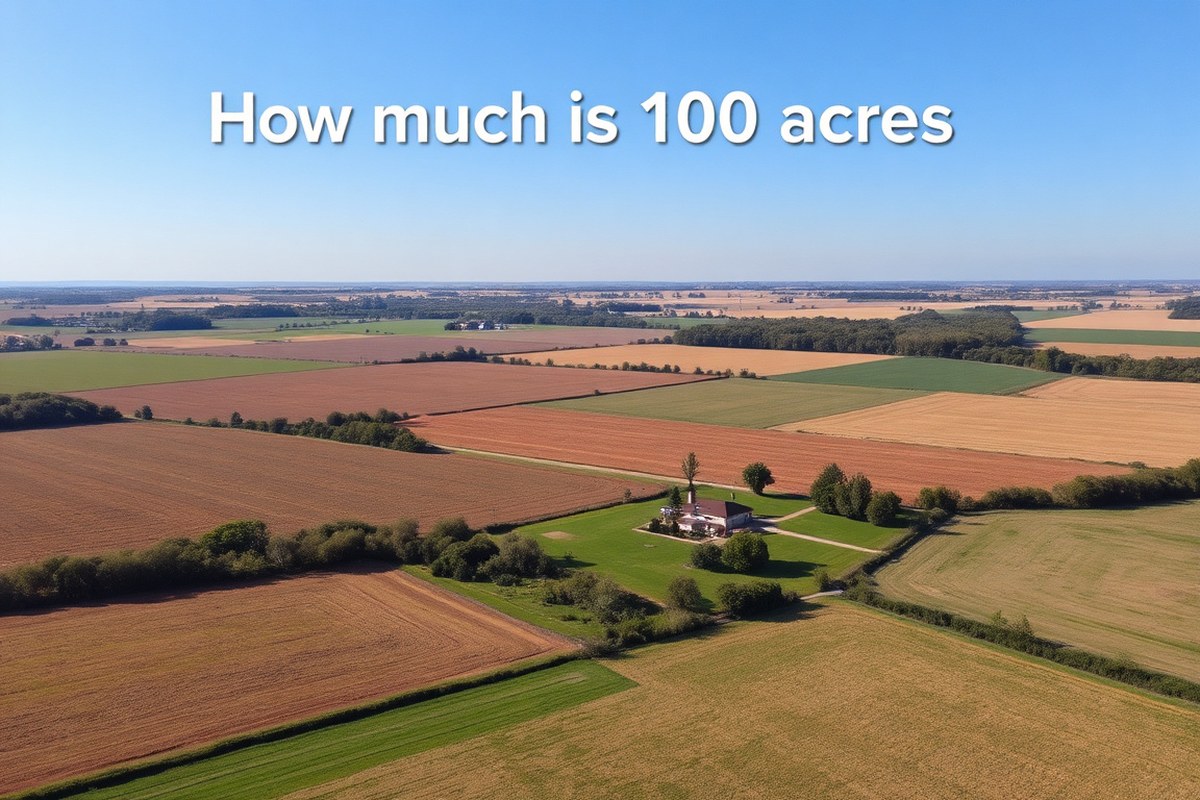
How Much Is 100 Acres: Costs, Size, Value, and Practical Uses Explained
Wondering how much is 100 acres? It depends on the land type and location. On average, 100 acres of farmland costs about $450,000.
But cropland is pricier, around $600,000. Pasture land is less costly, closer to $200,000 for 100 acres.
Prices for 100+ acre parcels usually range from $3,000 to $6,000 per acre. Suburban land is much more expensive than rural land. Keep in mind the final cost covers more than just land price.
Fees include surveys, taxes, and title work. Early research on local prices helps avoid surprises and find the best deals.
Visualizing 100 acres makes it easier to grasp. It’s about 15.6% of a square mile, the size of roughly 74 football fields.
Walking across such an area can take 30 to 60 minutes. Driving only a few minutes on rural roads.
Key Takeaways
- 100 acres equals about 4,356,000 square feet or 0.156 square miles.
- Farm real estate averages $4,500 per acre nationwide, but varies widely.
- Land with cropland is more expensive than pasture or mixed land.
- Expect extra costs for title, surveys, and first-year property taxes.
- Visualize 100 acres as roughly three times the size of a typical golf course.
- Walking 100 acres usually takes about 30 to 60 minutes, depending on terrain.
How Big Is 100 Acres in Square Feet and Miles?
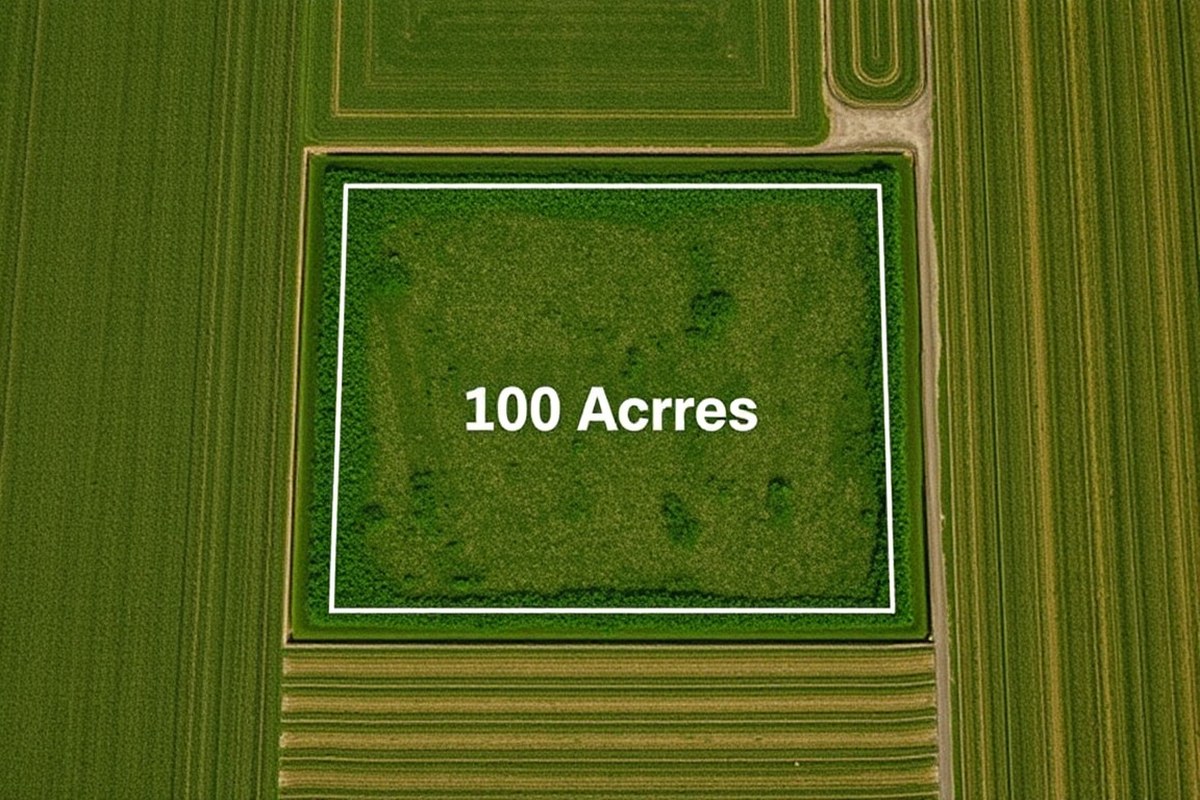
One hundred acres equals exactly 4,356,000 square feet. That number comes from the fact that one acre is 43,560 square feet. So, multiplying 43,560 by 100 gives you the total square feet for 100 acres.
When you want to convert 100 acres to square miles, the math shows it’s about 0.15625 square miles. This means 100 acres covers just over one-tenth of a square mile. For farmers and land buyers, thinking in square miles helps a lot.
It makes comparing large tracts easier on maps. You can see big land areas in a simple way.
Hectares are another common unit, especially outside the U.S. One acre equals about 0.4047 hectares. So, 100 acres is roughly 40.47 hectares.
This conversion matters if you’re dealing with agricultural reports or international standards. It’s good to keep these equivalents handy.
Making land size easier to grasp, a football field covers roughly 1.32 acres. Using this, 100 acres is close to 76 football fields placed side by side. This comparison helps when you want to see lots of land fast.
It works well for hobby farmers or small ranchers. You get a quick visual of the space you have.
For those who like meters, one acre equals 4,047 square meters. That means 100 acres convert to about 404,700 square meters. It’s helpful for detailed planning, like field layouts or fencing.
You can measure your land’s length and width in feet or meters. Then divide by 43,560 to convert the area to acres. This lets you switch between units anytime.
To summarize quick conversions: 100 acres equals 4,356,000 square feet, 0.15625 square miles, 40.47 hectares, or 76 football fields. These units give you real-world ways to picture or communicate your land’s size. Knowing how to convert lets you check maps, talk to sellers, and plan farming work confidently.
How to Visualize 100 Acres Using Familiar Landmarks
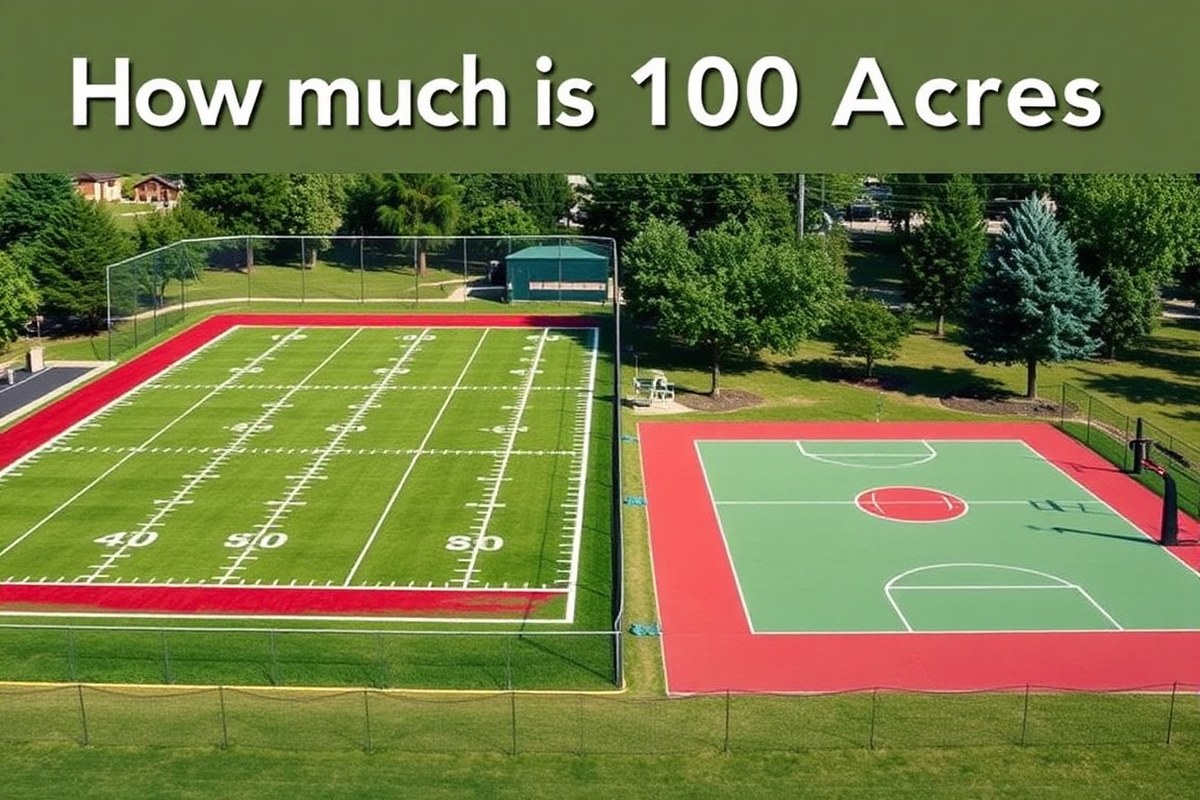
To picture 100 acres, imagine about 75 football fields laid out side by side. You can also compare it to places like shopping malls or large farms. Using maps or apps helps you see how much space this really is on the ground.
Visualizing 100 Acres with Football Fields
An American football field, including end zones, covers roughly 1.32 acres. That means 100 acres equals about 75 football fields. Lining up fields this way gives a clear visual of space.
One hundred acres looks broad and flat this way. You can really see how much land 100 acres covers.
This comparison works well because many people are familiar with football fields. It helps break down a large, hard-to-imagine number into a common, physical scale.
Landmarks Close to 100 Acres in Size
Large shopping malls typically cover 96 to 120 acres. For example, the Mall of America in Minnesota spans around 96 acres. Another example is a small farm or ranch.
These usually range from 80 to 150 acres. That fits right within this size range.
You can also think of 100 acres as about 0.16 square miles. It’s big enough to host a small castle estate or a large park.
Other Helpful Size Comparisons
Here is a list to help you picture 100 acres better:
- About 4.4 million square feet
- 75 football fields (including end zones)
- Almost the size of a large shopping mall (Mall of America: 96 acres)
- Nearly 0.16 square miles of land
- 64 soccer fields (varies by field size)
- A rectangular area 1,320 feet by 3,300 feet
- About 75 city blocks, depending on block size
These examples frame the size of 100 acres in practical ways. Knowing these measures helps when deciding on land use or planning property layouts.
Using Online Maps and Apps to Visualize Acreage
You can see 100 acres on mapping tools like Google Earth or radius map calculators online. Many apps let you draw shapes over maps showing exact acreages. This helps you understand land layout, boundaries, and shape.
Some tools offer free versions; others charge for more features. Using them costs nothing for basic areas. You just need a computer or smartphone and internet access.
Draw the property outline on an online map tool to visualize 100 acres precisely before buying.
Typical Costs to Buy 100 Acres of Land Today
Buying 100 acres of land costs vary widely depending on location and land use. Farm land tends to be cheaper per acre than residential lots. Extra fees and taxes add thousands to your total out-of-pocket cost.
Average Price Ranges by Land Type
Land prices per acre differ based on purpose and region. Farms in the Midwest average about $5,800 per acre. Residential land in suburban areas can cost over $5 million for 100 acres.
Commercial or industrial land often costs much more, sometimes tens of millions per 100 acres. Larger parcels sell for less per acre.
Buyers get a volume discount. There are fewer development costs per unit.
| Region | Avg. Price / Acre (2026) | Price Range for 100 Acres | Typical Land Use |
|---|---|---|---|
| Midwest (Iowa, Nebraska) | $5,800 | $460,000, $720,000 | Row crops, livestock |
| Southeast (Georgia, Alabama) | $9,200 | $750,000, $1,180,000 | Timber, hobby farms |
| Southwest (Arizona, New Mexico) | $3,400 | $280,000, $420,000 | Ranch, solar |
| West Coast (California, Oregon) | $16,500 | $1,230,000, $2,290,000 | Vineyards, orchards |
| Northeast (Pennsylvania, Vermont) | $11,700 | $920,000, $1,480,000 | Dairy, woodlots |
| Suburban Residential | Varies widely | $500,000, $5,000,000+ | Housing developments |
The wide price ranges show how land use and location greatly affect costs. Farms usually cost $2,800 to $11,800 per acre. Residential land near cities can jump to millions.
Common Additional Fees and Taxes
Extra costs to buy land add up quickly. A title search and recording typically cost $250 to $500 at closing. A survey of boundaries and topography runs $1,200 to $2,800 for 100 acres.
Property taxes depend on county but range from $3,200 to $7,500 yearly for 100 acres. Other fees can include soil tests costing $400 to $900.
Water rights transfers range from $1,500 to $4,000. HOA dues may also apply.
- Title search and recording: $250, $500
- Survey: $1,200, $2,800
- Soil testing: $400, $900
- Water rights transfer: $1,500, $4,000
- Property taxes (annual): $3,200, $7,500
- HOA dues (if applicable): $0, $2,600 per year
Planning these fees before you buy helps avoid surprises later. Some steps like surveys should happen before closing to confirm the land’s value and boundaries.
Example Total Purchase Cost Calculation
For 100 acres in Illinois, assume farmland costing $5,800 per acre. The base price would be $580,000. Add a boundary survey for $2,000 and title fees of $400 at closing.
Estimate the first-year property taxes at $4,500. Soil testing might cost $700. In this example, fees and taxes add about $7,600 on top of the purchase price.
- Land cost: 100 acres × $5,800 = $580,000
- Survey: $2,000
- Title search & recording: $400
- Soil testing: $700
- First year property taxes: $4,500
- Total out-of-pocket: $587,600
These fees and taxes raise your upfront cost. The increase is about 1 to 2 percent. Ignoring these often causes budgeting errors for land buyers.
Factors That Influence 100-acre Land Values and Pricing
Location greatly changes how much 100 acres costs. Land near cities or towns usually costs more because of easy access to jobs and services. Prices near Northeastern cities can be very high.
They sometimes cost multiple times more than rural land. Your land near roads, utilities, and shops will cost more. Proximity to schools also raises the price.
Remote land with poor access usually costs less. Prices may be in the tens of thousands, not millions.
Zoning rules dictate what you can do with the land and affect its market value. Agricultural zoning keeps land for farming or livestock and offers steady value based on productivity. Residential zoning allows building homes or subdividing into smaller lots, often raising the price considerably.
Commercial zones have the highest value because they support businesses and industries with revenue potential. Conservation zoning limits construction, so prices might be lower due to few development options.
Soil quality affects how good land is for farming. Better soil can lead to higher prices in farming areas. Checking soil means a lab test or county soil survey.
These tests look at fertility, drainage, and texture. Good soil means better crop yields or pasture quality, key for agricultural buyers. Water access matters a lot for land value.
Owning water rights or being near aquifers can increase price. Drilling wells costs $5,000 to $15,000 depending on depth. So it’s essential to verify water availability before buying.
Assessing land features like wetlands, steep slopes, or floodplains is critical. Wet or flood-prone areas reduce usable land and lower its price. You can usually see these features on topographic maps or county GIS websites.
Road frontage and legal access are important. Land without proper access is hard to use and sells for less. Adding infrastructure like power lines or gravel roads raises upfront costs but increases market value later.
Timber and scenic views add value in certain places, especially the Pacific Northwest. Large trees can bring income from logging. But cutting requires permits and reduces scenic appeal.
Waterfront land on lakes or rivers costs much more. Prices can reach hundreds of millions for 100 acres. Buyers value natural beauty and recreational use, which can outweigh other factors in pricing.
Look for signs a region is growing, like new housing developments or infrastructure projects. Land “in the path of progress” often increases in value faster. Review current land listings and recent sales nearby to see market trends.
Compare location, amenities, and zoning details carefully. Check if price premiums match your goals and budget.
How Long Does It Take to Walk or Drive Across 100 Acres?
A 100-acre plot shaped like a square measures about 2,087 feet on each side. To find this, take the square root of 4,356,000 square feet. 100 acres equal 4,356,000 square feet.
This gives you the length of one side in feet. For irregular plots, the distance across varies. So you measure the longest span with a GPS or mapping tool.
Walking 2,087 feet at 3 miles per hour takes about 7 to 8 minutes. You cover roughly 3 miles per hour when walking. It takes several minutes to cross that distance on foot.
This pace covers 264 feet per minute. So the math is 2,087 feet divided by 264 feet per minute. Driving speeds vary.
Driving across 100 acres at 15 miles per hour on a flat dirt road takes about 1 minute. The road’s even surface makes for steady travel. This time estimate assumes safe driving speed.5 minutes.
Terrain affects travel times a lot. Walking through flat pastureland is much faster than crossing dense woods or hilly ground. Vehicles slow down on rough or muddy surfaces.
So expect longer times if the land has poor road access or heavy vegetation. Time estimates assume straightforward paths without obstacles or steep climbs.
Use a GPS app to measure distances on irregular land before planning your walk or drive.
Common Practical Uses for 100 Acres of Land
One common use for 100 acres is farming. This size fits well for growing crops, raising livestock, or running mixed agriculture. A temperate climate lets you plant corn, soybeans, or wheat.
You can grow these crops on much of the land. This type of climate suits a wide range of farming. Some farmers keep dairy cows or beef cattle on pasture sections.
Beyond farming, 100 acres can hold housing developments or large residential estates. Local zoning rules matter for what you can build. You might develop 30 to 50 homes in a neighborhood.
The plan often includes roads and green spaces. Some prefer a single-family estate with plenty of room for barns, gardens, or private trails.
Recreational uses also work well on 100 acres. You can create hiking trails, hunting grounds, or small campgrounds.
Many national and regional parks start at this land size. Sports fields, horse arenas, or ATV tracks are possible, too.
- Farmland with crop fields, livestock pens, and storage barns
- Residential neighborhoods or luxury private estates
- State or community parks with trails and picnic areas
- Small commercial ventures like solar farms or horse stables
- Outdoor sports facilities such as soccer fields or riding arenas
You can use 100 acres for commercial projects like solar farms. Wind farms fit well in windy or sunny locations. These farms need space and proper natural conditions.
You could also develop agri-tourism sites, like farm tours or event venues. Checking the zoning rules is key before planning uses.
Some counties restrict commercial or dense housing developments. Others encourage rural farms and recreation.
Choose your project based on soil quality, water availability, and local market demand. Successful farming often requires good topsoil and access to irrigation.
Recreation and housing projects need proper permits and road access. Starting with a survey and speaking to local officials can save time and money.
Common Mistakes When Buying 100 Acres and How to Avoid Them
Buying 100 acres comes with common mistakes that lead to big problems later. One is ignoring hidden costs like property taxes, maintenance, and access roads. These fees can add thousands annually, so you need a clear budget before committing.
Another issue is relying on outdated or poor surveys. A bad survey can mean wrong boundaries or legal disputes with neighbors. Hire a licensed surveyor for a detailed, current land map.
Confirm land lines before you sign any papers. This step ensures your boundaries are clear.
Zoning rules cause trouble too. Some land may look open but restrict building, farming, or commercial use. Check local zoning laws at your county office or online.
Know what activities you can do freely. Also, find out if you need any permits.
- Don’t skip title searches to catch liens or ownership disputes.
- Ask for soil tests if farming or building is planned to confirm suitability.
- Look for environmental issues like wetlands or protected species that limit use.
- Visit the land multiple times at different seasons to spot access or water problems.
- Use a checklist of all local rules and fees; keep every paper documented.
- Get advice from a real estate lawyer or land specialist before big decisions.
Verifying boundaries starts with the survey. Request a mark of official corners and lines by a professional.
Walk the edges yourself or with the surveyor. This step prevents overlaps or encroachments that cause legal trouble.
Gather property tax IDs to check zoning restrictions. Look up parcel rules online or at the planning office. This helps you understand what the land allows.
You can ask for written confirmation on land use from officials. Find out permit costs and timelines early.
Avoid surprises by planning ahead. This saves time and money on your project.
Due diligence means reading all documents carefully and checking physical facts. Bring an experienced friend or hire a consultant to interpret technical details. Finding issues before purchase saves thousands and lost time.
Estimating Total Purchase Cost: Example and Checklist
Buying 100 acres means more than just the land price. You must add fees, taxes, and extras to get the full cost. A clear checklist helps you avoid surprises and make smart choices.
Step 1: Calculate Base Land Cost
Start by finding the price per acre from your land seller or agent. For example, if land costs $4,000 per acre, multiply that by 100 acres. That gives a base cost of $400,000 for the land alone.
Prices vary by location and land type. Agricultural land often costs less than pasture or recreational land. Keep in mind the market can change the price by thousands per acre.
Step 2: Add Typical Fees and Taxes
Besides base price, expect these extra costs:
- Pay closing costs around 1% to 3% of the purchase price, about $4,000 to $12,000 here.
- Include title and escrow fees, roughly $500 to $1,500 depending on providers.
- Budget for recording fees and transfer taxes tied to county rules, usually a few hundred dollars.
- Plan for property taxes. For farmland, these can range from $5 to $15 per $1,000 of value yearly.
- Check if a survey or land inspection is needed, which can cost around $500 to $1,000.
For the $400,000 land, assume $10,000 in closing and fees plus $1,000 survey costs. That brings you near $411,000 before taxes.
Step 3: Review Checklist Before Purchase
Be sure to complete these steps before finalizing the deal:
- Verify land boundaries with a professional surveyor or existing survey documents.
- Check zoning, water rights, and any easements or restrictions affecting the land use.
- Review past property tax records and outstanding taxes or liens.
- Confirm utility access, road maintenance, and any required permits for your intended use.
- Get a title search or insurance to clear ownership issues.
- Compare total costs with similar local sales to judge if the price is fair.
- Arrange financing and understand loan terms, if not paying cash.
Use these steps to avoid common land buying pitfalls and unplanned costs.
Double-check the property’s legal status before you pay. A title issue can cause serious delays.
Your First Steps to Buy and Use 100 Acres
Follow these clear steps to buy and make the most of 100 acres. Check each step off to stay on track and avoid common pitfalls.
- Before you start: Decide your main use for the land, like farming or hunting. This helps narrow your search and budget.
- Week 1: Research prices in your target area. Check recent sales online or through a local broker to know fair costs.
- Week 2: Walk or drive on similar-sized properties to understand terrain and boundaries. This gives you realistic expectations.
- Week 3: Hire a licensed land surveyor to verify exact boundaries and land features. Confirm this to avoid surprises later.
- Week 4: Review zoning and land-use rules with local planning offices. Make sure your plans comply and no restrictions apply.
- Week 5: Arrange financing or proof of funds before making offers. This speeds up the buying process.
- Week 6: Make an offer with help from a real estate agent who knows rural properties. Negotiate based on your research.
- After purchase: Plan your land improvements or uses step-by-step. Check your first projects succeed by clear milestones like fenced areas or planted crops.
Frequently Asked Questions
How Much Does It Cost to Maintain 100 Acres Annually?
Annual maintenance for 100 acres depends on usage. Farm land may require $10,000 to $50,000 yearly for upkeep, equipment, and labor. Budget more if you have buildings or crops that need care.
Spend less if the land is mostly wild or unused. This helps you plan your money better.
Can 100 Acres Support a Small Farm with Livestock?
Yes, 100 acres can support a modest farm with livestock. For example, you might raise cattle on pasture or have orchards with enough space for grazing. Proper land management is key to maintaining soil health and animal welfare on this acreage.
What Are Common Zoning Restrictions on 100-acre Parcels?
Zoning rules vary but can limit building, farming, or subdividing 100-acre parcels. Rural zoning often allows agriculture but not dense housing. Check local zoning ordinances before buying to avoid surprises about land use on large parcels.
How Does Property Tax Typically Scale with 100 Acres?
Property tax on 100 acres varies by state and land type. Agricultural land usually has lower rates than residential land. Expect taxes to cost several thousand dollars each year.
Local tax rates and values can change this a lot. Check with local tax offices to know your cost.
Is 100 Acres Large Enough for Commercial Timber Harvesting?
Yes, 100 acres can be large enough for timber harvesting if it’s forested. Sustainable management allows selective cutting without clearing all trees. This size can offer a good balance between revenue and manageable care.
Can You Get a Mortgage Specifically for Buying 100 Acres?
Mortgages for 100-acre land purchases exist but terms differ from home loans. Lenders often require larger down payments and proof of land income potential. Explore agricultural or rural land loan options with local banks or USDA programs.
Before You Go
One hundred acres offers plenty of space with varied uses depending on location and care. Start by defining your goals clearly. Reach out to a local expert to explore properties that fit your budget and plans.