

One Section Is How Many Acres? A Complete Guide to Land Sizes and Divisions
One section is 640 acres. A section covers one square mile, measuring 5,280 feet on each side. This measurement applies across most of the U.S. That uses the Public Land Survey System.
This standard helps break down large land areas efficiently. It simplifies land measurement for buying, selling, and surveying real estate. Knowing a section equals 640 acres is useful in these processes.
Sections often split into halves, quarters, or eighths. Smaller divisions are common in agricultural land sales. The price per acre usually changes with parcel size.
Surveyors use the system to set property boundaries accurately. Farmers and buyers rely on it for planning and managing land. Understanding section size makes real estate deals clearer and fairer.
Key Takeaways
- A section is always one square mile or 640 acres.
- Each side of a section measures exactly 5,280 feet.
- Half sections equal 320 acres, and quarter sections are 160 acres.
- A quarter-quarter section, or “forty,” consists of 40 acres.
- Smaller parcels, like 1 to 5 acres, usually cost more per acre.
- The Public Land Survey System uses sections for land division and mapping.
How Many Acres Are in One Section of Land?

A section of land measures exactly one square mile. This means it is 5,280 feet long on each side.
A section covers 640 acres in total. This is a standard size across the United States.
One acre equals 43,560 square feet. A mile is 5,280 feet long on each side. You multiply 5,280 by 5,280 to get the area.
That equals 27,878,400 square feet. Dividing that by 43,560 square feet per acre confirms a section is exactly 640 acres.
Sections serve as a common land unit in real estate and agriculture. Usually, one section contains 640 acres.
But land corners or natural features can cause small size differences. Always check the deed or survey for exact acreage when buying or surveying land.
What Is the Public Land Survey System and How Sections Fit into It?
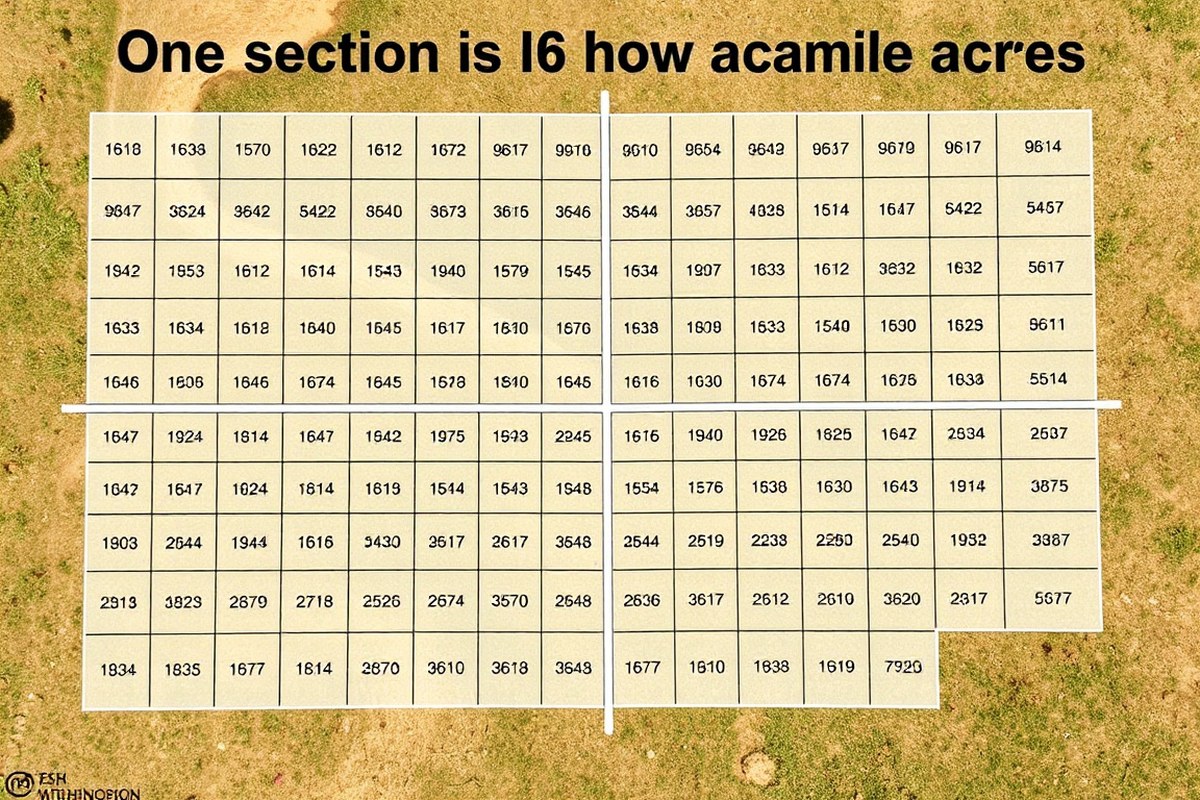
The Public Land Survey System (PLSS) maps out land using a grid of townships and sections. A township is a square area that measures 6 miles on each side. This means a township covers 36 square miles in total.
Each township is divided into 36 sections arranged in a 6-by-6 grid. Each section measures 1 mile by 1 mile, which equals 640 acres of land. These sections are the basic units used to describe and buy land.
One township has 36 sections. Each section covers 640 acres. So, a township totals 23,040 acres (36 times 640).
This layout makes finding land parcels simple. You can measure and record land easily. Thirty states use PLSS for this.
Remember, township and section boundaries are survey lines. So actual land can vary a bit with the terrain and survey methods used.
How Is a Section Divided into Smaller Parcels and What Are Their Acreages?
A section of land usually measures 640 acres total. It is split into smaller parts. These include half, quarter, and quarter-quarter sections.
Each subdivision cuts the section into smaller, manageable parts for farming or selling. Knowing these sizes helps you understand land descriptions and plan land use effectively.
Half Sections Explained
A half section is exactly half of a full 640-acre section. So it measures 320 acres. The land shape is one mile by half a mile.
Or it could be the other way. This depends on how the land is divided. This is often called the north or south half of a section.
You might see it as N 1/2 or S 1/2. Both mean the same thing.
Half sections suit medium farms or large, easy-to-manage plots. They also make selling easier. Many landowners prefer this size for practical reasons.
Dividing land like this helps sharing or development go smoothly. It avoids creating very small land pieces. This makes legal and farming tasks simpler.
Quarter Sections Size and Shape
A quarter section is half of a half section, making 160 acres. Each side of the square measures half a mile. Names like NW 1/4 or SE 1/4 show the exact location.
This size is popular with farmers. It’s big enough for crops or livestock but small enough for a single family to handle. You might hear about quarter sections a lot in land deals and farm sales.
The Forty-Acre Quarter-Quarter Section
A quarter-quarter section, often just called a “forty,” is a quarter of a quarter section. This means 40 acres, measured as 1/4 mile by 1/4 mile square. With 1,320 feet on each side, it’s a manageable size for many uses.
This small parcel suits hobby farms, homes, or specialized crops. Splitting land down to forty-acre blocks helps with flexible buying or selling. Sometimes, a half of this forty (20 acres) is used as well.
The table below shows common parcel sizes, shapes, and acreage in the Public Land Survey System:
| Parcel Type | Fraction of Section | Acreage | Dimensions |
|---|---|---|---|
| Full Section | 1 | 640 acres | 1 mile x 1 mile |
| Half Section | 1/2 | 320 acres | 1 mile x 1/2 mile |
| Quarter Section | 1/4 | 160 acres | 1/2 mile x 1/2 mile |
| Half of a Quarter | 1/8 | 80 acres | 1/2 mile x 1/4 mile |
| Quarter-Quarter Section (Forty) | 1/16 | 40 acres | 1/4 mile x 1/4 mile |
These subdivisions allow you to break the section into smaller plots depending on your needs. You can keep track by multiplying 640 acres by the fraction in the description. This same system helps when land pieces get smaller.
It makes land descriptions clearer and easier to follow. That helps buyers, sellers, and surveyors work better.
Are All Sections Exactly 640 Acres? Exceptions and Variations
The usual size for one section is 640 acres. But not all sections match this exactly.
Variations happen because of natural boundaries like rivers or lakes that cut through the land. These features force surveyors to adjust section lines to fit the real landscape.
Surveying errors can also create discrepancies. Early surveys often faced challenges like rough terrain, unclear landmarks, or less precise tools. These issues caused some sections to be slightly larger or smaller than the standard 640 acres.
Legal descriptions need to reflect these differences correctly. If a section is not exactly 640 acres, the property deed, title, and survey have to specify the exact measurements. This makes ownership and land use clear, preventing disputes.
- Natural boundaries forcing irregular section shapes
- Surveying inaccuracies from older equipment and rough terrain
- Correction lines used to adjust for earth’s curvature
- Government surveys vs. Metes and bounds descriptions
- Fractions or special parcels like fractional sections near lakes
- Road allowances that cut off parts of sections
- Legal adjustments recorded in deeds and plat maps
Correction lines account for the earth’s curve and help keep township lines straight. These cause some sections, especially on the edges of townships, to be smaller or larger. Fractional sections, mostly near water, can be much smaller than 640 acres.
Before buying land, checking the current survey and legal description is necessary. Surveys updated with modern tools show the exact acreage and boundaries. This information is important for buyers, farmers, and anyone using the land for agriculture or development.
How to Calculate Acreage from Fractional Parts of a Section
You calculate acreage from fractional parts of a section by multiplying 640 acres by each fraction. Then you combine those values if you have more than one fraction. This method works because one full section equals 640 acres.
Understanding Section Fraction Notation
Land descriptions often use fractions to denote parts of a full section. For example, “south half” means 1/2 of the section, which is about 320 acres. These fractions can chain together, slicing the section into smaller parcels.
Each fraction reduces the total size. When you see fractions like 1/2 and 1/4, multiply them.
This finds the part of the whole. This shorthand matches how properties are divided legally and physically.
Stepwise Acreage Calculation
Follow these steps when converting fractional parts to acres for combined portions of a section. This way you avoid confusion and get an exact figure.
- Start with the total size of one section: 640 acres.
- Write down each fraction from the legal description, such as 1/2 or 1/4.
- Multiply 640 by the first fraction to find that part’s acreage.
- When you have more than one fraction, multiply them all first. Then multiply by 640.
- For multiple parcels, calculate acreage for each separately.
- Add the acreages for all parcels to get the total combined acreage.
- Double-check the fractions and math to avoid errors.
For example, three-quarters of a section is 640 x 3/4 = 480 acres. To get half of three-quarters, multiply 640 by 3/4. Then multiply that result by 1/2.
Checking Results for Accuracy
Always confirm you read fractions correctly and multiply in the right order. Misreading a fraction doubles or halves the result mistakenly. Cross-check calculations with a calculator or spreadsheet if you can.
A few common mistakes include mixing denominators or forgetting to multiply all fractions. Also, consider that slight variations happen if the section isn’t a true 640 acres. When in doubt, ask a licensed surveyor.
Small errors in fractional input can lead to big acreage mistakes. Verify all fractions carefully.
Common Names and Terms for Acreage Within a Section
Popular land terms like “quarter section” and “back forty” help you understand land size quickly. A quarter section is exactly 160 acres, or half a mile by half a mile. This size became standard under the Homestead Act of 1862, where settlers claimed 160-acre plots.
The “back forty” refers to a smaller parcel within a quarter section. It refers to 40 acres, a quarter of a quarter section. This land is often remote or the least-used farmland.
Each quarter section splits into four 40-acre parcels. This makes the term common for rural land sections.
Real estate listings often use these terms to describe property size and location. For example, a listing might say “quarter section.”
It usually means about 160 acres but can be less after surveying. Knowing these terms will help you interpret acreage and parcel boundaries better.
- Quarter section: 160 acres, or a quarter of a one-mile square section
- Back forty: a 40-acre parcel, usually a remote quarter of a quarter section
- Forty: a 40-acre piece, common in land surveys and farming
- Quarter-quarter section: 40 acres, a quarter of a quarter section
- Section: a full one-mile square, totaling 640 acres
Other terms for 1,000 acres or similar sizes don’t have standard names in this system. The quarter section and forty are common terms. They match property laws and farm layouts in many U. S. Areas.S. The quarter section’s history affects land values and ownership patterns today.
When you see these names on property deeds or listings, you can picture actual dimensions. For example, Section 8’s northeast quarter equals 160 acres.
Taking the northwest quarter of that equals 40 acres. This is also called one of the “forties.””
How to Interpret Section Descriptions on Property Deeds and Legal Documents
Reading land descriptions means understanding sections, townships, and ranges on deeds and legal documents. These labels help you locate and size the property. But the actual survey sets the final boundary.
Knowing how to decode these parts helps you check land size. It also helps you find the exact position from old paperwork. This works even with complex land documents.
Decoding Section and Township Numbers
A township is a six-mile by six-mile square that contains 36 sections numbered 1 through 36. Each section is usually one square mile, or about 640 acres.
Townships are identified by how many are north or south of a base line. How many ranges they are east or west of a principal meridian.
For example, “Township 3 North, Range 5 East” means something specific. It shows the property is three townships north of the baseline. It also means five ranges east of the meridian.
Together, these coordinates narrow down the land to a specific area within a grid. This system was created to describe rural property before street addresses existed.
Understanding Directional Fractions
Abbreviations like NE 1/4 or S 1/2 describe fractional parts of a section. “NE 1/4” means the northeast quarter of the section, which is roughly 160 acres. “S 1/2” means the southern half, or about 320 acres.
These fractions show how the section is divided into smaller parcels. Sections split in halves, quarters, or even smaller parts allow precise descriptions. Multiplying the fractions by 640 acres helps you calculate the actual size of that parcel.
Matching Description to Physical Land
The legal description shows approximate size and location. You should still verify boundaries with an official survey. This ensures accuracy before making any land decisions.
Surveys may show irregular shapes and acreage that differ from the simple fractions. Land features, roads, or prior claims might change what is actually owned.
Check deeds against county records, survey maps, and GIS data to confirm size and boundaries. Reading each part carefully, section, township, range, and directional fractions, builds a clear picture. This step helps avoid surprises when buying or managing rural land.
How Section Size Affects Land Value and Buying Decisions
Land price per acre usually falls as parcel size grows. Buying a full 640-acre section often costs less per acre than buying smaller chunks. Large parcels appeal for farming or development.
They can limit buyers with less cash. Different uses may not fit big land sections.
Costs vary widely by location and land type. For example, raw desert land can go for under $300 per acre. Highly productive Iowa cropland can exceed $30,000 per acre.
Bigger parcels usually cost less per acre to buy. Buyers pay less for dividing, legal, and transfer fees. These lower costs make bigger lands cheaper.
| Parcel Size | Typical Price per Acre | Example Total Cost |
|---|---|---|
| Full Section (640 acres) | $300, $30,000+ | $192,000, $20 million+ |
| Quarter-Quarter Section (40 acres) | $400, $35,000+ | $16,000, $1.4 million+ |
| Smaller Parcels (under 40 acres) | $500, $40,000+ | Varies widely |
Subdividing a section gives flexibility to sell or use smaller tracts. However, doing so costs extra for surveys, legal work, and approvals.
Smaller parcels tend to sell at a higher price per acre. Those higher prices can cover subdivision costs over time but may not pay off quickly.
Think about how you plan to use the land before buying a whole section. Buying a full section saves money if you farm or hold land. For residential or hobby use, smaller parcels might fit your budget better despite higher per-acre costs.
Check local zoning and subdivision laws before buying land. This is important if you plan to split the land later.
Step-by-Step Action Plan for Using Section Acreage in Land Deals
Use this plan to check section sizes and acreage for smarter land buying or surveying.
- Before You Start: Gather your land deed or legal description. Verify it mentions the section number or township details.
- Day 1: Find the Public Land Survey System (PLSS) maps online. You can also visit the county office to see them in person. This helps you get the basic land layout. Confirm how the section fits in the grid.
- Day 2: Identify if the section is full-size (640 acres) or fractional. Use maps or survey data to judge section boundaries.
- Day 3: Divide the section into smaller parts like quarters or quarters of quarters. This helps you know the exact size in acres. It makes measuring easier and more precise. Calculate those if needed.
- Week 1: Look for any odd shapes or interruptions in the land. Check for features like rivers or roads crossing the section. These can affect the land’s shape and size. Adjust acreage expectations.
- Week 2: Compare the land value per acre with other similar-sized parcels in the region. Look for pricing clues tied to section size.
- After 2 Weeks: Consult a licensed surveyor or real estate professional for final verification before buying. Confirm that all measurements match legal documents.
Frequently Asked Questions
What Is 40 Acres of Land Called?
Forty acres is known as a quarter-quarter section. It measures roughly 1,320 feet on each side. This size is common in land surveying parcels.
Is 640 Acres Considered a Section?
Yes, 640 acres equals one full section of land. It forms a square that is one mile long on each side.
What Is 320 Acres Called?
320 acres is called a half section. It represents half of a full 640-acre section, typically split north-south or east-west.
How Many Acres Is an Entire Section?
An entire section contains exactly 640 acres. This is one square mile of land, or 5,280 feet on each side.
How Many Square Miles Make Up One Section of Land?
One section equals one square mile. That means its area totals 640 acres, laid out in a perfect square.
Can a Section of Land Be Smaller Than 640 Acres?
Yes, some sections vary due to surveying errors or natural boundaries. Check local records to confirm exact sizes.
Key Points to Remember
One section usually contains 640 acres. But size can vary due to natural or legal factors.
Knowing exact acreage helps you assess land value and make better buying choices. Start by checking your land’s section and acreage details today to avoid surprises later.


