How Much Land Is 20 Acres? A Complete Guide with Visuals and Examples
You might want to know the exact size of 20 acres. That size matches about 16 football fields put together. It’s a large area that can hold many things.
Twenty acres is quite a big land area for many uses. Farmers grow crops or ranchers keep animals on such plots. Home builders also like this size for new houses and yards.
It’s easier to imagine 20 acres by comparing it to familiar places. For example, it can equal about 15 city blocks in some towns. These comparisons give a clearer picture of the space.
Focus on the shape and location of the 20 acres first. These affect how useful and valuable the land can be for you. Knowing the exact dimensions helps plan what fits well on your land.
Key Takeaways
- One acre is 43,560 square feet, so multiply by 20 for total area.
- A square 20-acre lot measures about 933 feet on each side.
- Typical city blocks are about five and a half acres for scale.
- 20 acres contain roughly 21 standard basketball courts in area.
- Walking around a square 20-acre parcel covers about 3,733 feet.
- Land shape impacts usability more than just total acreage.
How Big Is 20 Acres in Square Feet and Meters?
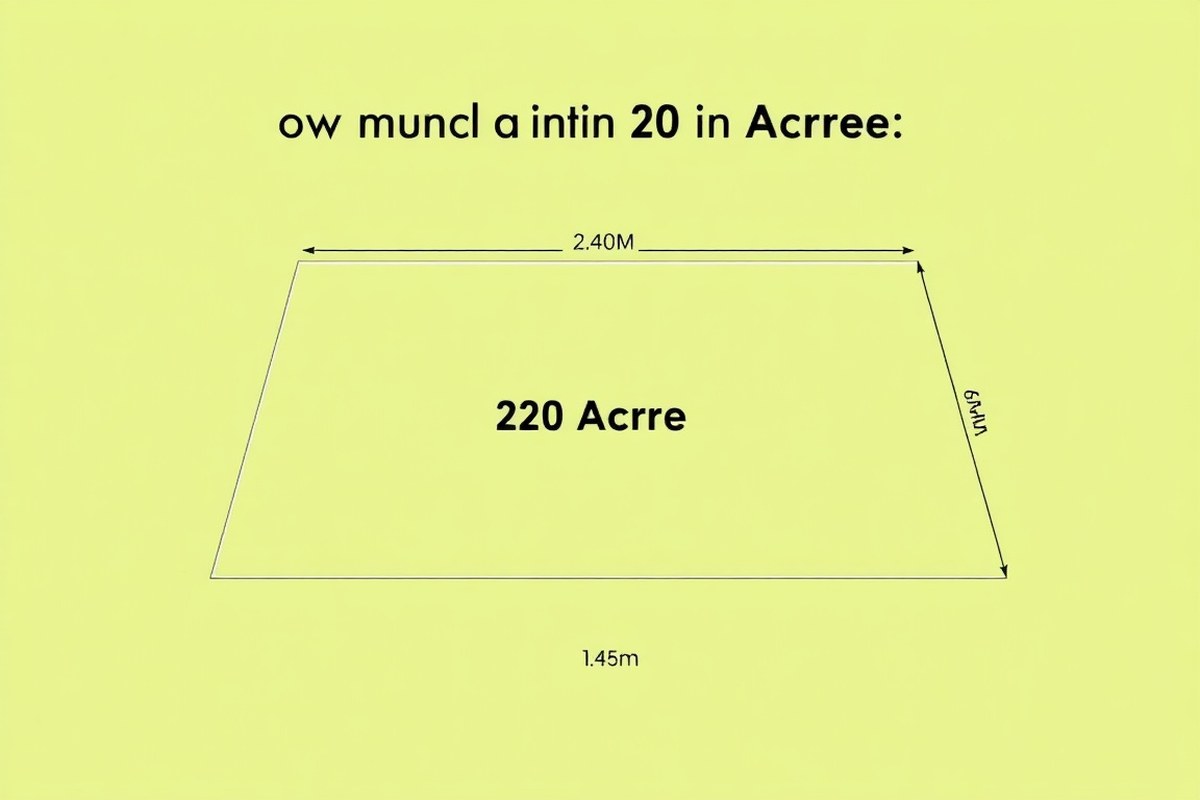
Twenty acres equals exactly 871,200 square feet. One acre measures 43,560 square feet, so multiply that by 20.
For example, 43,560 × 20 = 871,200 square feet. That’s a lot of ground to cover or build on.
In square meters, which works better for metric use, 20 acres is about 80,937 square meters. One acre is about 4,047 square meters, so multiply that by 20. The math looks like this: 4,047 × 20 = 80,940 square meters, rounded slightly for convenience.
You can also convert 20 acres into square yards. Since one acre equals 4,840 square yards, just multiply by 20.
That gives 20 × 4,840 = 96,800 square yards. This unit is handy if you deal with smaller plots or textile measurements in land deals.
To find acres from square feet, divide by 43,560. Say you have a plot 100,000 square feet in size.
It’s 100,000 ÷ 43,560 ≈ 2.3 acres. Planning your land purchase or build means checking these values carefully to understand plot size.
In practice, land rarely fits into perfect squares or rectangles. Still, understanding these conversions helps you picture the land. A perfect square that covers 20 acres is about 933 feet each side.
Knowing sizes in square feet and meters helps when comparing land listings. You want to confirm the size tightly, especially if you’ll develop or farm the land. Clear math stops surprises on the deed or survey.
Typical Dimensions and Shapes of 20-Acre Parcels
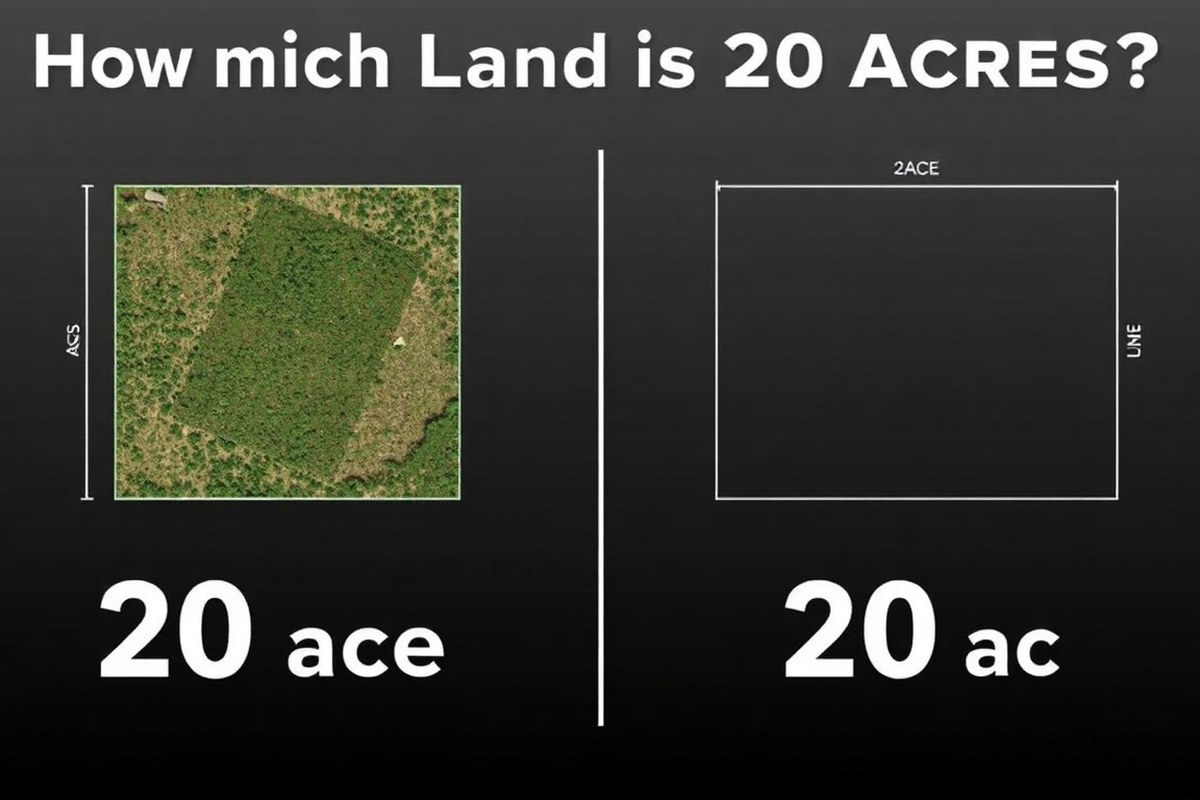
A 20-acre parcel can take many shapes. But the most common are square and rectangular. The shape changes the perimeter a lot.
This affects how much fencing you need. More perimeter means more fence or boundary work. Knowing typical dimensions helps you estimate costs and plan layout efficiently.
Square 20-acre Parcel Dimensions Explained
A perfect square 20-acre parcel has each side measuring about 933.38 feet long. This comes from taking the square root of 871,200 square feet, which equals roughly 933.38 feet. The total perimeter of a square parcel is four times this length, around 3,733 feet.
Since all sides are equal, fencing is straightforward to calculate and install. People often like square shapes for land.
Squares need less fence for the same area. That keeps fencing costs lower.
Rectangular Parcel Examples and Their Perimeters
Rectangles can have different lengths and widths. But the area must be 871,200 square feet. This equals 20 acres.
For example, a plot 1,200 feet long and 726 feet wide will total near 20 acres. Calculating the perimeter involves adding length and width, then multiplying by two.
Different rectangular shapes can stretch the perimeter well beyond the square parcel’s 3,733 feet. A narrower, longer lot needs more fencing, which raises costs.
| Parcel Shape | Length (ft) | Width (ft) | Area (sq ft) | Perimeter (ft) |
|---|---|---|---|---|
| Square | 933.38 | 933.38 | 871,200 | 3,733 |
| Rectangular (Example 1) | 1,200 | 726 | 871,200 | 3,852 |
| Rectangular (Example 2) | 1,500 | 581 | 871,500 | 4,162 |
| Rectangular (Example 3) | 1,000 | 871 | 871,000 | 3,742 |
The table shows that a parcel shaped closer to square has a lower perimeter. Rectangles with more length than width can add hundreds of extra feet of fencing. This affects both cost and installation time.
How Irregular Shapes Change Perimeter and Fencing Needs
Land parcels often differ from perfect squares or rectangles due to terrain or property lines. Irregular shapes usually have longer perimeters than simple geometric shapes with the same area. More corners and bends mean more fencing materials and labor.
Knowing the perimeter can be tricky without a survey or accurate land measurements. It’s best to get a professional survey if your parcel is oddly shaped or has curves. This avoids surprises in fencing length and cost.
Don’t guess fencing needs on irregular parcels, get an accurate survey to avoid extra costs.
How Long Does It Take to Walk Across and Around 20 Acres?
Walking across or around 20 acres depends heavily on the shape and your walking speed. For a square 20-acre plot, expect about 13 to 14 minutes to walk the perimeter.
Walking straight or diagonally across the plot takes about 11.5 minutes. This is on flat ground and at an average walking speed.
Calculating Walking Time for a Square 20-acre Parcel
A square 20-acre parcel covers about 871,200 square feet. Each side measures roughly 933 feet since the square root of 871,200 is about 933.
Walking the entire perimeter means covering four sides, or about 3,732 feet total. At a normal walking speed of 3 miles per hour (about 4.8 km/h), you cover 4,400 feet per minute divided by 60, roughly 220 feet per minute.
Walking around the perimeter takes just under 17 minutes at that pace. Walking straight across one side (933 feet) takes just over 4 minutes. Diagonally across the square is longer, about 1,320 feet.
So that takes around 6 minutes. Both look different but help understand how much time you need.
- Measure the side length by taking the square root of 871,200 (square feet in 20 acres).
- Multiply side length by four to find the perimeter.
- Choose your walking speed, like 3 miles per hour.
- Convert speed to feet per minute (3 MPH is 264 feet per minute).
- Divide perimeter by feet per minute for total walking time around.
- For walking across, divide side length or diagonal length by feet per minute.
Adjusting Estimates for Rectangular or Irregular Shapes
Not all 20-acre parcels are square. Rectangular or oddly shaped lots change your walking distances. A long, narrow rectangle may stretch your walking time across the land but shorten the perimeter.
Shapes like L or triangle increase the boundary length. That makes the perimeter walk longer than usual.
You can still estimate time by breaking the perimeter into straight segments and summing their lengths. To find a rectangle for 20 acres, multiply length by width. That equals 871,200 square feet.
Find perimeter with 2 times length plus width. Walking speed converts distances to minutes the same way as square plots.
How Walking Conditions and Speed Affect Your Timing
Your walking speed, fitness, terrain, weather, and obstacles change how long it takes. Average walking speed on flat, level ground is about 3 MPH or 4.8 km/h. Rough, uneven, or overgrown terrain could cut that speed by half or more.
Walking uphill or carrying gear slows you down too. Adjust your timing estimates by decreasing average speed for challenging areas.
To estimate walking time on uneven terrain, divide distances by your slower speed. For example, if you normally walk at 3 MPH but expect to go 1.5 MPH on rough ground, your walking time doubles. Always add extra time for breaks or difficult spots on large parcels.
Visual Comparisons: 20 Acres vs Sports Fields and City Blocks
You can picture 20 acres by stacking familiar sports fields or city blocks side by side. Twenty acres equals about 15 football fields laid out from end zone to end zone. The same space fits roughly 310 tennis courts, giving you another way to see the size.
City blocks vary across the U.S. Dense urban blocks, like Manhattan’s, measure close to 2 acres each. You could fit 10 of these blocks into 20 acres.
That shows just how much space 20 acres offers. It’s a lot in a city setting.
| Real-World Landmark | Approximate Size | How Many Fit in 20 Acres |
|---|---|---|
| American Football Field (including end zones) | 1.32 Acres | 15.1 Football Fields |
| Standard Walmart Supercenter (store only) | 2.5 Acres | 8 Walmart Supercenters |
| Manhattan City Block | 2.0 Acres | 10 City Blocks |
| Professional 18-Hole Golf Course | 110-190 Acres | About 1/7th of a Course |
| Standard Tennis Court | 0.06 Acres | 333 Tennis Courts |
Besides sports and city blocks, 20 acres is close to eight Walmart Supercenters. That’s a useful comparison if you know the size of these big stores. For golf fans, 20 acres covers just one-seventh of a full 18-hole course.
Here’s how to visualize it: imagine laying out 15 football fields together. That helps you see the land’s width and length in familiar terms. Imagine 10 city blocks in a busy urban area.
You could also fit over 300 tennis courts side by side. This shows how 20 acres add up quickly. These give you practical landmarks to understand the scale of 20 acres.
How Many Homes, Parking Spaces, and Other Uses Fit on 20 Acres?
On 20 acres, you can fit about 87 to 116 average-sized homes. Typical suburban lots range from 0.1 to 0.25 acres each. For example, with 0.2-acre lots, you’d have 100 homes comfortably spaced with yards and access roads.
Each home needs room for the house, driveway, and some yard space. Larger estate lots around 0.About 20 to 40 homes fit on 20 acres using 5 to 1 acre lots. This size offers more privacy for each home.
Zoning rules and layout affect these numbers a lot. So you must check local laws before planning.
Acreage also fits parking spaces well. One acre can hold 150 to 160 parking spots. This includes space for aisles and drive lanes.
Multiply that by 20. You get roughly 3,000 to 3,200 parking spots on 20 acres. This works for big lots like shopping centers or event venues.
Aside from homes and parking, 20 acres support other uses. A standard elementary school campus with buildings, fields, and parking often covers about this area. Small farms or hobby farms will find 20 acres enough for crops, livestock, and buildings.
You can also mix uses on 20 acres. For example, build homes with shared green or recreation spaces.
For practical estimates, measure the usage area rather than the whole land. Open land, slopes, or protected zones can limit buildable space.
Roads and utilities take up room too. Planning with these factors in mind avoids overcrowding or wasted land.
Use local rules and real lot sizes to calculate homes. Don’t just divide 20 acres by an average lot size. This prevents surprises during development.
What Factors Influence the Value and Usability of 20 Acres?
Location strongly affects land prices. In popular metro areas or dense states, land can cost over $100,000 per acre. In rural areas, prices often drop to under $5,000 per acre.
For example, 20 acres in a metro edge might run $2 million. 20 acres in a remote county could be $60,000.
Steep slopes, rocky ground, or wetlands limit usable space and lower value. Flat, well-drained land with good soil boosts farming and building potential. Topography controls how much of those 20 acres you can practically develop or grow on.
Zoning laws set what uses the land allows. Residential, agricultural, commercial, or mixed zoning all come with rules.
You might build one custom home, subdivide into smaller lots, or farm depending on local regulations. Always check zoning before buying.
Access to roads, utilities, and water influences both value and usability. Land with paved road access and utility hookups generally costs more.
Water rights or wells are important for farming and homesteading. Without these, your options shrink.
| Region | Price Per Acre |
|---|---|
| Dense metro outskirts | $100,000+ |
| Suburban or exurban areas | $20,000 – $50,000 |
| Rural farmland | $3,000 – $10,000 |
| Remote land | Under $3,000 |
Before buying, assess these key factors to know what you’re getting. Check the site’s slope and soil quality with a soil test kit or parcel survey.
Review local zoning maps online or at the planning office. Drive to the property to verify road access and utility hookups.
A good step is comparing nearby recent sales to estimate fair market value. Ask the seller for land surveys and title info.
Poor results come from ignoring zoning or buying land with no practical access. That can turn 20 acres into unusable, costly property.
How to Calculate Acreage and Understand Land Measurements
Calculating acreage accurately helps you understand the true size of land. Measure your plot’s length and width, then convert those measurements into acres. Knowing common survey units and using the right tools will improve your estimate.
Manual Acreage Calculation Formula and Example
Use a simple formula to find acreage from land dimensions. Measure length and width in feet, then divide the total square feet by 43,560. This number equals the number of acres.
Follow these steps to calculate acreage manually:
- Measure the length of the land in feet using a measuring tape or survey tool.
- Measure the width of the land at its widest point in feet.
- Multiply length by width to get total square feet (Length × Width = Sq. Ft).
- Divide the total square feet by 43,560, the number of square feet per acre.
- Record your result. This is your land’s acreage estimation.
For example, your land might be 660 feet long. It could be 1,320 feet wide.
Multiply 660 by 1,320 to get 871,200 square feet. Then divide 871,200 ÷ 43,560 = 20 acres.
Standard Land Surveying Units Explained
Your land may be described using chains, rods, or other old units. One chain equals 66 feet, while one rod equals 16.5 feet. These are common in legal descriptions and surveys.
Understanding these units helps you better read surveys or property documents. For example, a standard chain length often forms parcel boundaries in rural areas. Furlongs, equal to 10 chains or 660 feet, can describe longer distances.
Knowing about these units lets you convert measurements easily and compare your land to legal descriptions. It also helps with surveying when maps use these older terms.
Recommended Tools and Apps for Acreage Measurement
Using tools like a GPS device or digital surveyor apps gives more precise acreage results. Many free and paid apps can calculate land area by tracing property lines on aerial maps. This saves time and avoids measurement errors.
Try tools like the Land Measurement Tool, which shows layouts visually and calculates acreage automatically. You can also use apps like Google Earth or specialized farm or real estate apps. Some apps allow measurements in feet, meters, chains, or rods.
For best results, combine app estimates with physical measurements or survey documents. Check your land shape carefully if it is uneven or sloped.
Irregular or sloped land may change the size you calculate. Always double-check to make sure your measure is right.
Practical Examples of What 20 Acres Can Accommodate
Twenty acres can support a variety of farming operations like small-scale crop farming or livestock grazing. A typical small farm might use 5 to 15 acres for growing vegetables, fruits, or grains. The remaining land could house barns, equipment storage, and pasture for animals.
You can plan a small residential development on 20 acres, depending on local zoning. Many rural areas require at least 2 to 5 acres per home lot.
So you could fit about four to ten houses here. Allowing space for roads and utilities means you’ll need to carefully map lot sizes and infrastructure.
Recreational projects like a private park, a campground, or sports fields fit well on 20 acres. For example, a modest horse riding facility or community garden can use 10 to 15 acres. These projects benefit from natural features like trees or water bodies to add value and appeal.
Commercial uses include solar farms that make 2 to 4 megawatts. You can also build two small commercial buildings side by side.
Commercial development, however, requires extra space for sidewalks, parking, and alleys. That means the actual usable area shrinks compared to raw acreage.
Match the project to the land’s features: flat, cleared areas suit farming or solar. Wooded or sloped spots work better for recreation or housing.
Check local zoning and restrictions before you plan. Site layout is key; group structures to leave room for access and drainage.
Plan your layout early to avoid wasting space on roads and unusable edges.
Maximizing land use means balancing your goals with the land’s shape and soil quality. Placing buildings near the road saves you drive time.
This setup also leaves open fields for crops or recreation. You can also use fencing and natural barriers to protect crops or pets.
Prepare for costs related to land clearing, grading, and utilities, which can vary widely by location. Good planning and flexible designs help avoid common pitfalls like poor water drainage or limited access. A practical 20-acre plan fits your current needs and leaves room for future growth.
Step-by-Step Action Plan for Understanding and Using 20 Acres
Follow these steps to get a clear grasp of 20 acres. They guide you through measuring, visualizing, and planning uses effectively.
- Day 1: Measure your 20-acre parcel with a GPS or online tool. Confirm the size by checking it matches about 871,200 square feet.
- Day 3: Walk the perimeter to estimate distance. Time yourself to understand how long it takes around and across the land.
- Week 1: Sketch common shapes like rectangles or squares that fit 20 acres. Use these shapes to visualize your land’s dimensions.
- Week 2: Compare the land size to known areas, like sports fields or city blocks. This helps make the size real in your mind.
- Week 3: List possible uses, such as home building, farming, or parking. Estimate how many fit based on typical sizes discussed.
- Week 4: Research local land values and zoning rules. This will help you understand price ranges and what you may build or farm.
- After 1 month: Make a decision or plan based on your findings. Use your measurements and comparisons to choose the best use.
Frequently Asked Questions
How Much Is 20 Acres in Terms of Football Fields?
20 acres equals about 15 football fields. This helps picture the size without complex math.
Can 20 Acres Fit a Small Hobby Farm?
Yes, 20 acres can support a small hobby farm. This is enough for several animals and gardening space.
Is 20 Acres Enough Land to Build Multiple Homes?
Yes, you can build multiple homes on 20 acres. Local zoning rules will affect how many are allowed.
How Does Slope Affect Usable Space on 20 Acres?
Slope can reduce usable space on 20 acres by limiting development areas. Flat land is easier and cheaper to build on.
Can 20 Acres Include Wetlands or Protected Areas?
Yes, 20 acres might have wetlands or protected areas. These sections often have building restrictions.
How Long Does It Take to Drive Around 20 Acres?
Driving around 20 acres usually takes just a few minutes. It depends on the terrain and road conditions.
Before You Go
Twenty acres is a substantial piece of land with many possible uses. You can easily measure and visualize its size using simple tools. Start by walking your land’s perimeter to connect the numbers with real world experience.