Are Earthworms Insects? Clear Facts, Key Differences, and Why It Matters
Are earthworms insects? The short answer is no.
Earthworms belong to a different animal group called annelids, not insects. They have soft, segmented bodies without hard shells or wings, unlike insects.
Earthworms move through soil by contracting their muscles in a wave-like motion. Insects, however, have jointed legs used for walking, jumping, or flying. This difference in movement helps you tell them apart when you work in the garden or explore soil.
Earthworms also breathe through their skin, needing moist environments to survive. Insects usually have breathing holes called spiracles on their bodies. These traits show that earthworms and insects live and function very differently.
Watching body shape, legs, and movement helps you spot earthworms versus insects easily. Knowing these facts shows how important earthworms are for the soil compared to insects. It clears up the common mix-up about earthworms being insects, which they are not.
Key Takeaways
- Earthworms belong to annelids, not insects.
- Insects have legs; earthworms move by muscle contractions.
- Earthworms have no hard shells or wings.
- Look for segmented, soft bodies without legs to identify earthworms.
- Earthworms help soil health, unlike many insect pests.
- Deep-burrowing earthworms can tunnel up to 8 feet underground.
Are Earthworms Insects? The Clear Scientific Answer
Earthworms are not insects. They belong to a different group of animals called annelids. Unlike insects, earthworms have a long, segmented body without legs or antennae.
Insects belong to the phylum Arthropoda and have three body parts: a head, thorax, and abdomen. They also have six legs and an exoskeleton made of chitin. Earthworms do not have these features.
Their bodies are soft. They use fluid-filled segments as a hydrostatic skeleton.
People often mistake earthworms for insects because of their shape and size. Some insect larvae also look like worms, which adds to the confusion.
Earthworms move by contracting their segmented bodies. Insects walk or fly using legs and wings.
How Earthworms Differ from Insects: Key Physical Traits
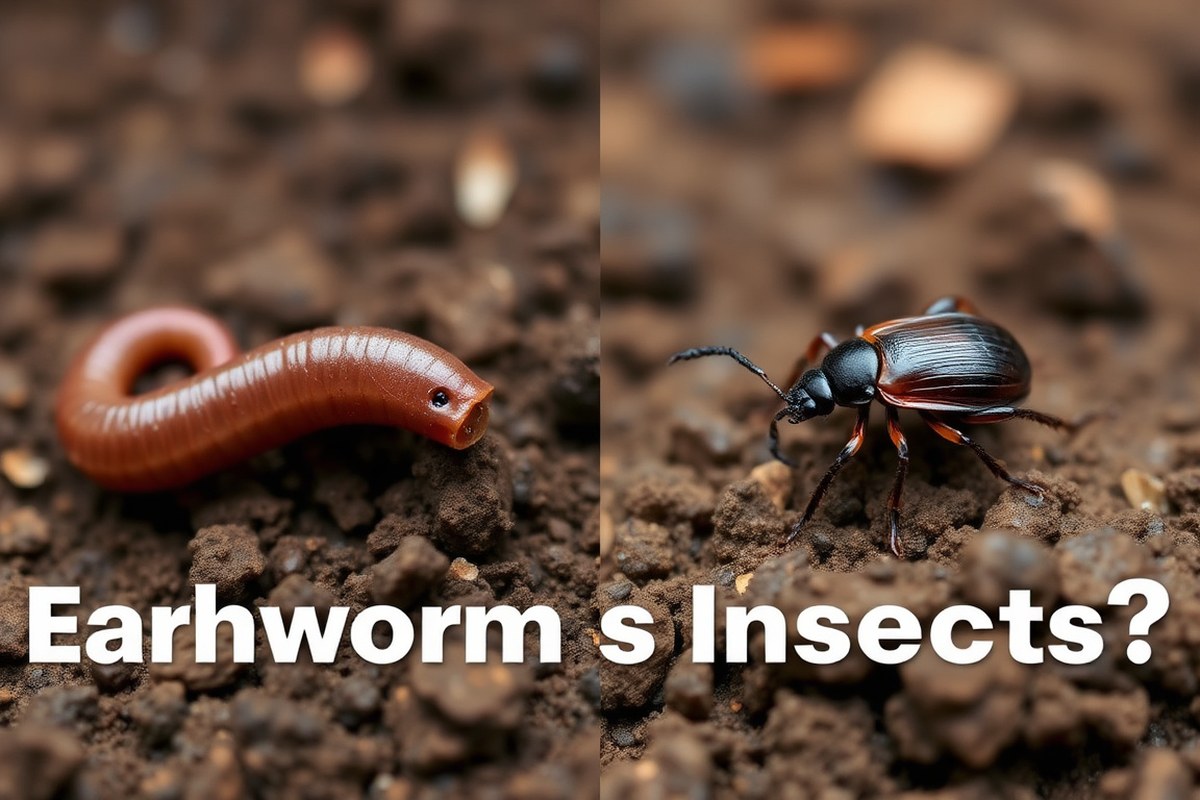
Earthworms and insects differ greatly in their body structure. Earthworms have no legs, antennae, or wings. They also lack a hard outer shell, unlike insects.
Insects have a rigid exoskeleton that protects their body. Their body divides into three parts: head, thorax, and abdomen. Earthworms’ bodies are more uniform and covered with soft skin instead.
| Feature | Earthworms | Insects |
|---|---|---|
| Legs | None | Six jointed legs |
| Antennae | None | Present |
| Body segments | Many ring-like segments | Three main parts |
| Exoskeleton | No | Yes, rigid and shed for growth |
| Movement method | Body undulation and bristles | Legs and sometimes wings |
| Size range example | Up to 10 inches (25.4 cm) | Varies widely, many tiny species |
Earthworms use muscles and tiny bristles called setae to move. These bristles help grip soil, letting worms push forward. They wiggle their bodies in waves to crawl through the ground.
Insects rely on their six legs for walking or running. Their antennae help sense the environment, which worms do not have. Wings also assist some insects in flying, a feature not found in earthworms.
Don’t confuse earthworms’ ringed bodies and bristles with insect legs, they are not the same.
Earthworm and Insect Biological Classifications Explained
Earthworms and insects come from separate groups in the animal kingdom. Earthworms fall under the Annelida phylum. Insects are part of the Arthropoda phylum, highlighting their biological differences.
Phylum Annelida: Earthworms and Relatives
Earthworms are part of the phylum Annelida, a group known as segmented worms. This phylum includes creatures like leeches, which share the segmented, ringed body structure.
Within Annelida, earthworms belong to the class Clitellata. Members of this class have a clitellum, a distinct collar-like band used in reproduction. The clitellum helps earthworms produce sticky cocoons for their eggs.
There are about 2,700 species of earthworms worldwide. Some, like the Giant Gippsland Earthworm, can grow extremely long, reaching nearly 10 feet. These worms live underground and play key roles in soil health.
Phylum Arthropoda: Insects and Their Kin
Insects fall under the phylum Arthropoda, which includes animals with jointed limbs and exoskeletons. This phylum also covers spiders, crustaceans, and centipedes.
Specifically, insects belong to the class Insecta. They typically have three body parts: head, thorax, and abdomen. Insects also have six legs and often two pairs of wings, features earthworms lack.
Arthropods are the most diverse animal group, with an estimated 30 million insect species. This vast difference in diversity shows their separate evolutionary paths from annelids like earthworms.
Differences in Body Plan and Skeleton
Earthworms have soft, segmented bodies without any hard external covering. Their bodies are cylindrical and made up of repeating ring-like segments.
In contrast, insects have a rigid exoskeleton made of chitin. This hard shell protects their internal organs and supports their body structure.
Earthworms move by contracting muscles in each segment, while insects use jointed legs. These differences in body plan reflect their distinct classification and lifestyles.
Common Earthworm Species and Their Characteristics
There are about 2,700 earthworm species worldwide, living in many soils except Antarctica. They vary in size, lifespan, and habitats, making them diverse creatures.
Some species are common in North America. Others come from Asia, Europe, or Africa.
Common Earthworm Species in North America
North America has at least 45 non-native earthworm species introduced mainly from Europe, Asia, and Africa. In Massachusetts alone, 21 species have been recorded, including familiar ones in gardens and forests. Notable species include:
- Amynthas agrestis: An invasive Asian species, often called the jumping worm.
- Allolobophora chlorotica: From Europe, common in moist soils.
- Aporrectodea longa: A European species found in agricultural soils.
- Bimastos parvus: Native to North America, seen in woodland areas.
- Lumbricus terrestris: Also known as the night crawler, native to Europe, abundant in North America.
These earthworms range from small, just a few inches long, to larger species reaching several inches. The night crawler is familiar to many gardeners and fishermen.
Unique Giants: The Largest Earthworms
While most earthworms are just a few inches long, some species grow to remarkable lengths. Some can reach 14 inches (35 centimeters) and appear snake-like.
Giant earthworms are found in various regions. The Australian giant Gippsland earthworm can grow up to 3 feet. It is not found in North America.
Habitats and Distribution
Earthworms live in many environments, from gardens to forests and grasslands. They usually remain in or near moist soil where organic matter is plentiful. They occupy distinct layers such as surface-soil and upper-soil:
- Surface-soil species live just below the soil or in organic layers.
- Upper-soil species burrow deeper and feed on soil and organic debris.
- Some species specialize in leaf litter while others consume roots.
- They thrive best in soils with temperatures between 50°F and 70°F.
- Earthworms avoid very dry or frozen soils during extreme seasons.
Their presence greatly affects soil quality, aeration, and plant health. Habitats with rich organic matter support larger populations and more species diversity.
Life Cycle and Reproduction Differences Between Earthworms and Insects
Earthworms reproduce by producing cocoons that contain their eggs. They do not go through metamorphosis.
In contrast, insects typically have complex life cycles involving distinct stages and metamorphosis. These differences affect how each develops and grows.
Earthworm Reproduction and Cocoon Production
Earthworms are hermaphrodites, meaning each worm has both male and female reproductive organs. They exchange sperm with another worm, then form a cocoon where fertilized eggs develop.
Cocoon production can happen any time during the year. But it peaks in spring and has a smaller peak in the fall. Worms seal the eggs inside these cocoons, which protect the young during development.
The young earthworms hatch inside the cocoon, resembling tiny adults without any larval stage. This simple process keeps their life cycle straightforward and direct.
Insect Metamorphosis and Development Stages
Most insects go through metamorphosis, which changes their body structure as they grow. They start as eggs, hatch into larvae or nymphs, then transform into pupae before becoming adults.
This process allows insects to occupy different environments and eat different food types during stages. The larval form often looks worm-like, but it’s not an earthworm at all.
The time for an insect’s life cycle varies widely. Some complete metamorphosis in weeks, while others take months. These changes enable insects to adapt and survive in many habitats.
Direct vs Indirect Development
Earthworms develop directly from eggs to miniature adults within the cocoon. They do not undergo drastic changes in form after hatching, so no metamorphosis occurs.
Insects, however, usually develop indirectly by changing body form significantly through metamorphosis. They shift from larva to pupa and then to adult, which looks entirely different.
This indirect development allows insects to specialize in feeding and living conditions at different life stages. The difference affects how they fit into ecosystems. It also affects how you study or manage them.
Remember, earthworms hatch fully formed. So spotting larvae means you’re likely seeing insect juveniles, not young earthworms.
Ecological Roles: Why Earthworms Are important, Not Insect Pests
Earthworms improve soil by breaking down plant residue into nutrient-rich humus. This process feeds tiny microorganisms that boost soil fertility and structure. Earthworms pull leftover plant material into the soil.
This process enriches the ground. It helps plants absorb nutrients better.
Burrowing by earthworms creates tunnels that let air and water reach plant roots. These channels reduce soil compaction, helping roots grow deeper and take up moisture more easily. Deep-burrowing earthworms like nightcrawlers dig tunnels up to 8 feet deep.
These tunnels improve soil drainage. They also increase aeration for roots.
Plants benefit because earthworms release nutrients locked in dead material, making them readily available. Healthy soil with earthworms supports stronger, more resilient crop and garden plants. Without earthworms, soil can become dense and poor in nutrients, which slows plant growth.
Many ecosystems, such as forests, grasslands, and farmlands, rely on earthworms for soil health. These worms live in moist, dark soil where they recycle organic matter. Their activity supports a wide range of soil organisms and helps maintain a balanced food web.
Earthworms rarely damage plants or people. Unlike some insects, they do not invade homes. They mostly help the soil instead.
They mostly feed on decaying matter and small bits of soil. Some insects can harm plants or spread disease. But earthworms consistently play a helpful role in gardens and wild environments.
Why Earthworms Are Often Mistaken for Insects and How to Tell Them Apart
Many people think earthworms are insects because both seem similar at first glance. They’re small, long, and have soft bodies that wiggle in the soil. Also, some insect larvae look worm-like, which adds to the confusion.
Insect larvae often have no legs or tiny, undeveloped ones. These small legs don’t look like adult insect legs. This causes many people to mix them up.
Earthworms never have legs. Instead, they move with muscle contractions along their segmented bodies. Earthworms grow 3 to 8 inches long.
They have smooth and shiny bodies. They don’t have wings or antennae. In contrast, insects always have six legs and may have wings and antennae.
A useful way to tell earthworms apart is to check the body shape. Earthworms have multiple similar segments without clear body divisions like a head, thorax, and abdomen. Insects have these three parts clearly visible.
Earthworms often tie themselves in knots in hot or dry weather. This is a behavior insect larvae do not show. It helps earthworms survive tough conditions.
People commonly believe earthworms are pests like some bugs. This myth likely comes from confusing earthworms with harmful insect larvae.
Earthworms, in fact, improve soil quality by aerating it and breaking down organic matter. They’re not harmful and don’t eat plants like many insect pests.
To identify an earthworm, check for no legs or wings. Look for a smooth, segmented body with shiny skin. Notice if it ties itself in knots on hot days.
Also, make sure the creature doesn’t have a distinct head with antennae or eyes. An insect or insect larva always has six legs or wings. If you see these, it is not an earthworm.
Another myth says all small, worm-like creatures in your garden are insects. This isn’t true because worm-shaped bodies appear in several animal groups.
You can always check for legs and body segments to be sure. Knowing these differences helps you appreciate earthworms as helpful soil friends, not pests.
Environmental Factors Affecting Earthworm Behavior Compared to Insects
Earthworms prefer cool, moist environments between 50 and 70 degrees Fahrenheit. They need damp soil because they breathe through their skin. When soil gets too dry, earthworms burrow deeper underground.
They also enter estivation, a light sleep state. This helps them survive heat or drought.
In contrast, many insects tolerate wider temperature ranges and moisture levels. Some insects remain active in hot, dry conditions by sheltering in shaded areas or under leaves.
Earthworms struggle outside moist soil and avoid sun exposure. So their activity drops sharply in dry or hot weather.
Earthworms cannot survive underwater for long because they still need some oxygen. Their burrows help them access air inside moist soil. But flooding forces them to the surface where predators may find them.
Insects have many ways to survive flooding. Some fly away to safety. Others go dormant for a while.
Gardeners noticing fewer earthworms during summer likely face heat and dry soil conditions. To keep earthworms active, water your garden regularly, especially in hot weather. Avoid acidic soil conditions and heavy use of manure that can harm earthworm populations.
In colder climates, earthworms like Amynthas spp. Die off during winter, but their cocoons wait for spring warmth to hatch.
Unlike earthworms, many insects survive cold by migrating, hibernating, or producing antifreeze-like chemicals. Knowing this helps gardeners plan for seasonal soil health and pest control.
Water your soil deeply early in the morning. This helps protect earthworms during dry spells. It keeps them active and healthy.
Step-by-Step Action Plan to Identify Earthworms and Insects
Use this plan to tell earthworms and insects apart and understand their roles. Follow each step to build confidence in recognizing these creatures.
- Day 1: Look closely at a ground creature you find outside. Check if it has legs and a hard outer shell. If it doesn’t have legs or a shell, it’s likely an earthworm.
- Day 3: Count the body sections. Find if the creature has three main parts like insects do: head, thorax, and abdomen. Earthworms have many similar segments but no distinct body sections.
- Week 1: Examine the skin. Earthworms have soft, moist skin without wings or antennae. Insects usually have a hard exoskeleton and may have wings.
- Week 2: Observe movement. Earthworms move by contracting their muscles and are slow. Insects typically walk using jointed legs and can be faster.
- Week 3: Learn about their role in your garden. Notice if the creature improves soil health, meaning it’s probably an earthworm. Pests damaging plants are usually insects.
- Week 4: Read a field guide or check online for local earthworm and insect species. Confirm your observations with photos and descriptions.
- Month 2: Share your findings with a nature group or teacher. Testing your knowledge helps you remember the key differences.
Frequently Asked Questions
Are Earthworms Insects?
No, earthworms are not insects; they belong to a different phylum called Annelida. Insects belong to Arthropoda and have features earthworms lack, like legs and exoskeletons.
Do Earthworms Have Legs Like Insects?
Earthworms do not have legs, unlike insects that typically have six legs. Earthworms move by contracting their muscles and using tiny bristles on their bodies.
Can Earthworms Survive Underwater Like Some Insects?
Yes, earthworms can live weeks underwater due to their ability to absorb oxygen through their skin. This is different from most insects that breathe through spiracles.
Why Do People Confuse Earthworms with Insects?
People confuse earthworms with insects because both are small and live in soil. However, earthworms lack insect traits like antennae and segmented body regions.
Are Earthworms Harmful Like Some Insect Pests?
Earthworms are not harmful; they benefit soil health by aerating it. Insects can be pests, but earthworms improve plant growth through their burrowing.
How Do Earthworm Life Cycles Differ from Insect Life Cycles?
Earthworms develop directly without metamorphosis, unlike insects which undergo stages like larvae and pupae. Earthworms hatch from cocoons and look like small adults.
Before You Go
Earthworms are not insects but a different group of animals with many simple segments. Spotting legs, body parts, and skin type helps you tell them apart. Next time you see a wriggler, use these tips to identify it confidently.